Claude training for companies works when you run it like a hire, not a course. The AI gets a job, a manager, limits on what it may do alone, and a review, and the training ends with one delegated job running inside your organisation. Anything that ends in a certificate instead is awareness, and awareness does not move a number.
I have worked with AI for sixteen years, from speech and conversational systems inside Google, Cisco, Avaya and Uniphore to the agentic systems my team ships today. The pattern I watched in every one of those rooms is repeating now at a new speed: companies buy the technology faster than they learn to manage it.
The gap is not access to the model
Almost every serious company in the Gulf already has AI. 74 percent of GCC enterprises use generative AI in at least one function, yet only 7 percent earn more than 5 percent of their revenue from it (MIT Sloan / Fortune). Access is solved. Results are not.
The people side shows the same gap. 73 percent of Gulf employees see AI as a competitive edge, and only 14 percent have training provided by their employer (Ipsos / EXE, Q2 2026). Your staff are already using it, mostly without a standard.
Everyone has the same model. What separates the 7 percent is the operating system around it: who may ask it to do what, where its work is checked, and what it is never allowed to do alone.
Hiring AI is a management problem, not a software rollout
When you hire a person, you do five things without thinking: write the job, name a manager, set limits on what they can sign, check their early work, and review them. Most companies give AI none of the five. They buy seats, send a link and wait.
Claude training for a company should install exactly those five things, on your own Claude workspace, for real work.
| When you hire a person | When you hire AI in Claude |
|---|---|
| A job description | A role written down: the task type, the input, the output, the standard |
| A manager | A named human owner per task type, never "the team" |
| Signing authority | A decision rule: assist, delegate or autonomous |
| Probation | Approval gates before anything leaves the building |
| Onboarding | A department brain: your context, standards and templates, loaded once |
| Performance review | A score gate, and 30 days of supervised use after the training |
The decision rule: assist, delegate or autonomous
The single most useful thing a manager can leave training with is one rule per task type. There are only three settings.
- Assist. Claude drafts, a person decides and sends. Right for anything client-facing in month one.
- Delegate. Claude does the work end to end and a person approves at a gate before it goes out. Right for repeated internal work with a clear standard.
- Autonomous. Claude runs within written limits and a person reviews the log, not each item. Right only after the gate has held for weeks.
Most task types start at assist or delegate. The rule also names the kill switch: who can stop a job, and how fast. Without it, AI use drifts from task to task depending on who is holding the keyboard.
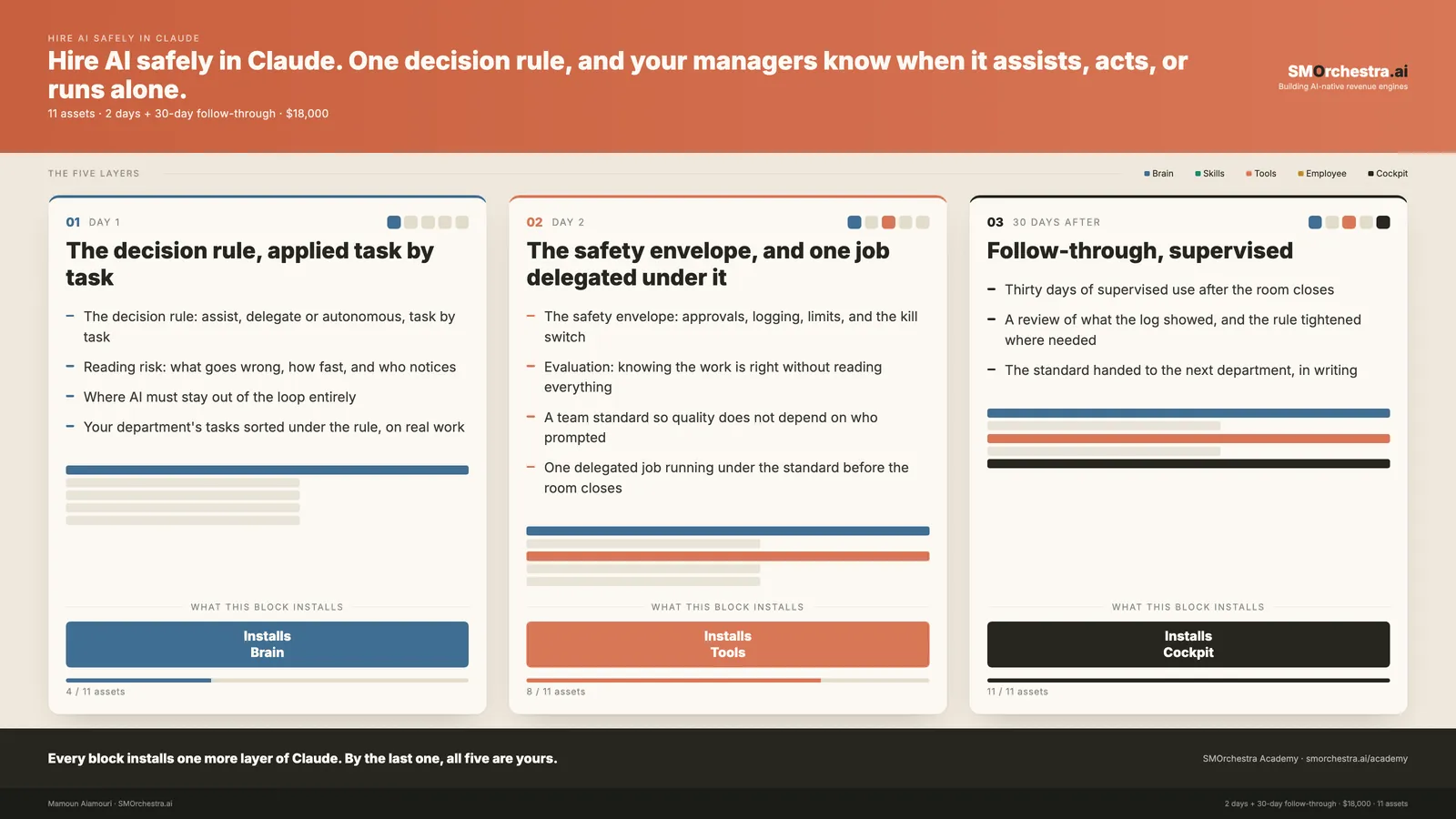
This is the core of Hire AI Safely in Claude: two days plus 30 days of follow-through for up to 20 managers, ending with the department's AI operating standard in writing and one delegated job running under it.
Five questions, in the order organisations actually ask them
Corporate AI training fails when it answers a question nobody in the room is asking yet. The questions arrive in a predictable order, and each one deserves its own program.
- Can I trust it? The board and executive committee need named accountability and evidence that humans can still intervene. Who Signs Off When Claude Is Wrong? is half a day for them.
- Can my managers run it? The decision rule above. Most organisations start here.
- Can my team work this way? Every participant hires one AI employee on the function's real work, with a shared department brain behind them: Build Your AI-Native Employees in Claude.
- Can it carry a number? Marketing, sales and GTM rebuilt as one agentic engine on your own CRM: Build Your AI-Native Revenue Engine in Claude.
- Can it run itself? One department's way of working turned into an operating system your people run: Build Your Agentic Operating System in Claude.
Skipping ahead is the expensive mistake. A team that builds AI employees before its managers agree a decision rule builds five different standards, one per enthusiast.
What to demand from any Claude training provider
Whoever you hire to train your people, including us, hold them to seven tests. A program that fails two of them is selling attendance.
- It ends with something running. A job delegated to Claude and working on your accounts, not a certificate of attendance.
- It runs on your real work. Your workspace, your documents, your process. A sandbox teaches the sandbox.
- It leaves a written standard. Something your risk or audit function can read, challenge and sign.
- It is priced per cohort. Per-seat pricing rewards filling chairs, not changing how a department works.
- It follows through. The first 30 days after the room are where habits either form or die.
- It speaks your language. Arabic or English, on site or remote, with the examples drawn from your market.
- It counts toward what comes next. If you later build with the provider, the training fee should not be money spent twice.
Four ways companies buy Claude training
| Option | What your people leave with | On whose accounts | Usual pricing shape |
|---|---|---|---|
| Free online courses | Individual product literacy | Each person's own | Free |
| A general AI workshop | Slides, examples, often a certificate | A demo account, or none | Per seat |
| A consultancy rollout | A strategy and a roadmap | Varies; often built by the consultant | Per engagement |
| A hire-AI program | A written standard, approval gates, one job running | Yours, from day one | Per cohort |
Anthropic publishes free courses on using Claude, and they are a good start for individual literacy. They are not designed to set your organisation's operating standard, and nobody should expect them to.
What corporate Claude training costs
Our corporate programs are priced per cohort, never per seat, and scoped on one short call. Travel and venue are excluded, which is why the published figures are floors.
- Board session: $6,000 to $9,000 per session, half a day, up to 15 people.
- Hire AI Safely in Claude: from $18,000 per cohort, 2 days plus 30-day follow-through, up to 20 managers. That is $900 a manager.
- AI employees for teams: from $30,000 per cohort, 3 days, up to 20 seats.
- Revenue engine for teams: from $45,000 per cohort, 4 days.
- Agentic operating system: from $50,000, 4 to 6 weeks, one department.
- Built for your organisation: from $25,000, starting with a one-day diagnostic.
The fee is credited toward any SMOrchestra build signed within 90 days, up to that build's price. The full ladder, with what each program leaves behind, is on the corporate academy page.
What we admit
Training does not replace building. Some departments are better served by having the system built with them and handed over, which is what Build-Operate-Transfer is for.
A decision rule is only as good as the manager who enforces it. Managers who skip the second day, or the follow-through, leave with a document and no habit.
And AI output still needs review. The approval gates are the point of the program, not a formality to remove once people feel confident.
Where to start this week
Pick one department and one task it repeats every week. Write its decision rule in one line: assist, delegate or autonomous, and who approves.
If your managers cannot agree on that line in ten minutes, you have found the conversation the managers' program exists to settle.
Frequently asked questions
What is Claude training for companies?
How long does corporate Claude training take?
Is Claude training available in Arabic?
Do we need Claude licences before the training?
How is corporate Claude training priced?
Scope a cohort in 15 minutes.
One call: which program, which room, which language, and the number. No deck.
Book 15 minutes