Build-Operate-Transfer, applied to AI, means the vendor builds the system on your stack, operates it with your team until it produces, then hands over the code, the prompts, the SOPs, and the data. The deliverable is ownership. SMOrchestra runs the model on its flagship revenue engine in 12 weeks at $39,000, and every engagement ends with the client’s name on the system.
Ownership is the deliverable
Most AI engagements end with a subscription, a retainer, or a consultant who has to stay because only the consultant knows how the system works. Build-Operate-Transfer ends with a handover, and the handover is itemized: the repository and workflows, the prompt and scoring rubrics, the SOPs, the documentation, and enablement for up to 5 people across 3 working sessions.
Everything is built on accounts the client controls from day one. The CRM is the client’s CRM. The channels are the client’s channels. Transfer changes who operates the system, and nothing has to migrate.
Three phases, and Transfer runs inside Operate
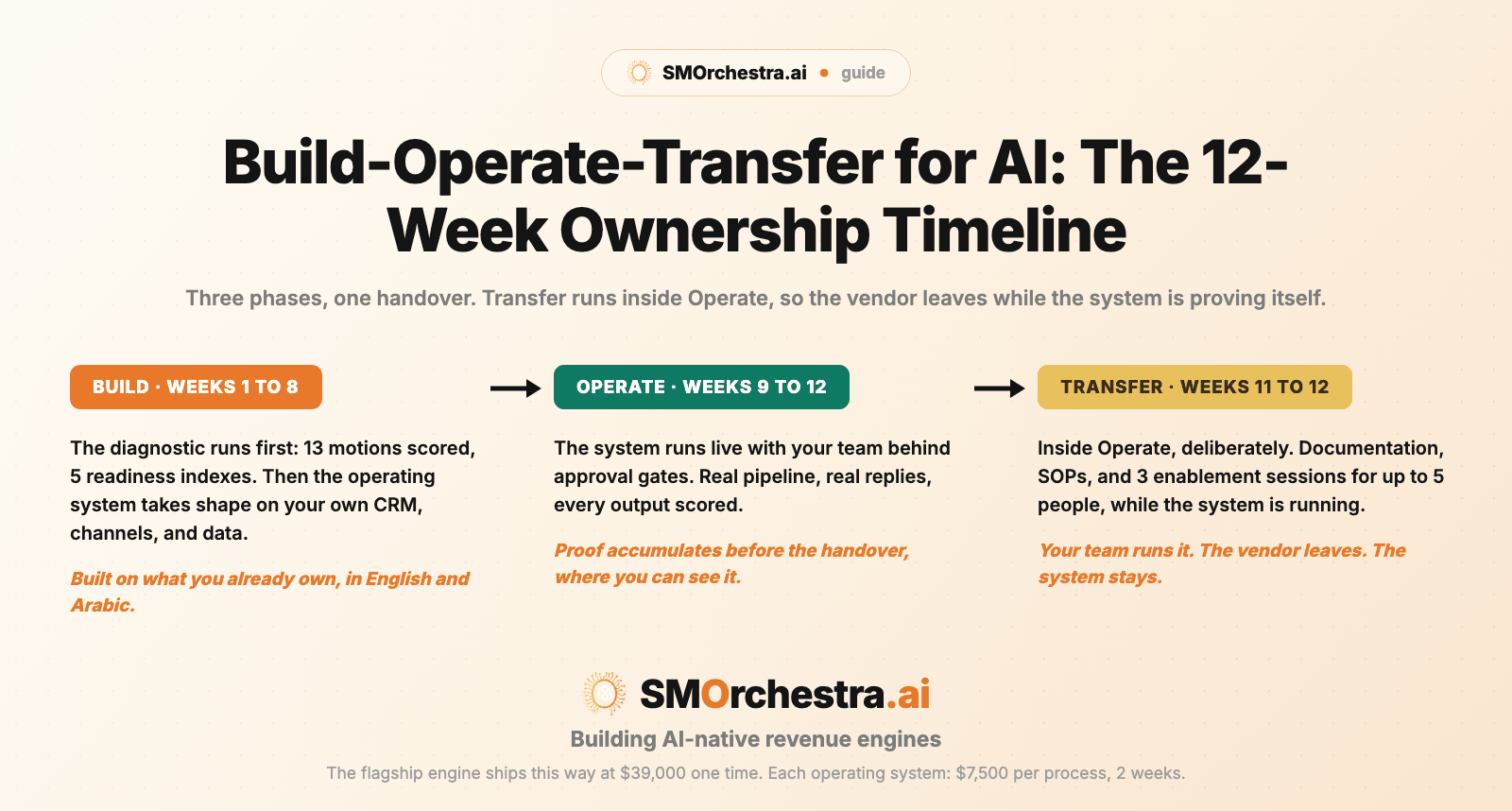
Build takes weeks 1 to 8. The diagnostic runs first, 13 motions scored against 5 readiness indexes, then the operating system takes shape on the client’s own stack, in English and Arabic.
Operate takes weeks 9 to 12. The system runs live with the client’s team behind approval gates. Real pipeline, real replies, every output scored before it ships. Proof accumulates where the client can see it, on the client’s own dashboards.
Transfer runs in weeks 11 and 12, deliberately inside Operate. The team learns the system while it is running and producing, with the builder still in the room. A handover meeting held after the vendor has packed up is where installed systems go to die.
Where the model runs today
The flagship B2B revenue engine ships this way: 12 weeks, $39,000, one time. The revenue operating systems apply the same model to one business process at a time, $7,500 per process and 2 weeks each. The MicroSaaS build transfers a repository and its data at week 14 for $45,000.
Three different products, one commercial spine: built on what you own, operated to proof, transferred on a named date.
What to demand from any BOT vendor
Ask for the transfer inventory in the proposal, with the enablement sessions counted. Ask whose accounts the system is built on, and walk away if the answer is the vendor’s. Ask what the operating weeks are measured on, and expect scored outputs and live pipeline rather than a demo. Ask what renews after the transfer date, and expect the answer to be nothing.
A vendor who resists those four questions is selling a retainer with extra steps.
Frequently asked questions
What does Build-Operate-Transfer mean for AI systems?
What exactly transfers at the end?
Why does Transfer run inside Operate instead of after it?
What does a Build-Operate-Transfer engagement cost?
What if the team cannot run it after the handover?
Map your pipeline in 15 minutes.
A working session, not a pitch. Bring your last ten deals; leave knowing whether a Build-Operate-Transfer install even makes sense for you.
Book 15 minutes