In Claude Cowork, context belongs in skills and projects, and folders are stations where work enters and leaves. The folders-are-dead advice circulating right now gets the first half right and the second half expensively wrong. Here is the split, from a company that runs on Cowork daily.
The advice, and the half of it that is right
The claim you will hear: Cowork understands everything, so stop organising files and just talk to it. The kernel of truth is real. Context, meaning who you are, your standards, your method, your templates, your definition of good, has a proper home now, and that home is skills, plugins and project instructions.
Pasting your company description into a folder, or worse into every chat, is doing the machine's job for it. The people saying this part are right, and this site has said it too: method belongs in plugins, written once, versioned, installed everywhere.
The mistake is the leap from that truth to the conclusion that structure itself is obsolete. Work still needs a place to stand.
Context and variables are different substances
Context is what stays true across every task. Your voice, your scoring gates, your architecture decisions, your refusal rules. Write it once, version it, let every session inherit it.
Variables are what change every time. This week's inputs. This client's brain. This build's handover. Last month's scorecards. No skill should contain them, because they are true for exactly one engagement.
Confuse the two in either direction and you pay. That is the whole doctrine, and one screenshot shows what it looks like when it is right.
Six numbered folders from a live build
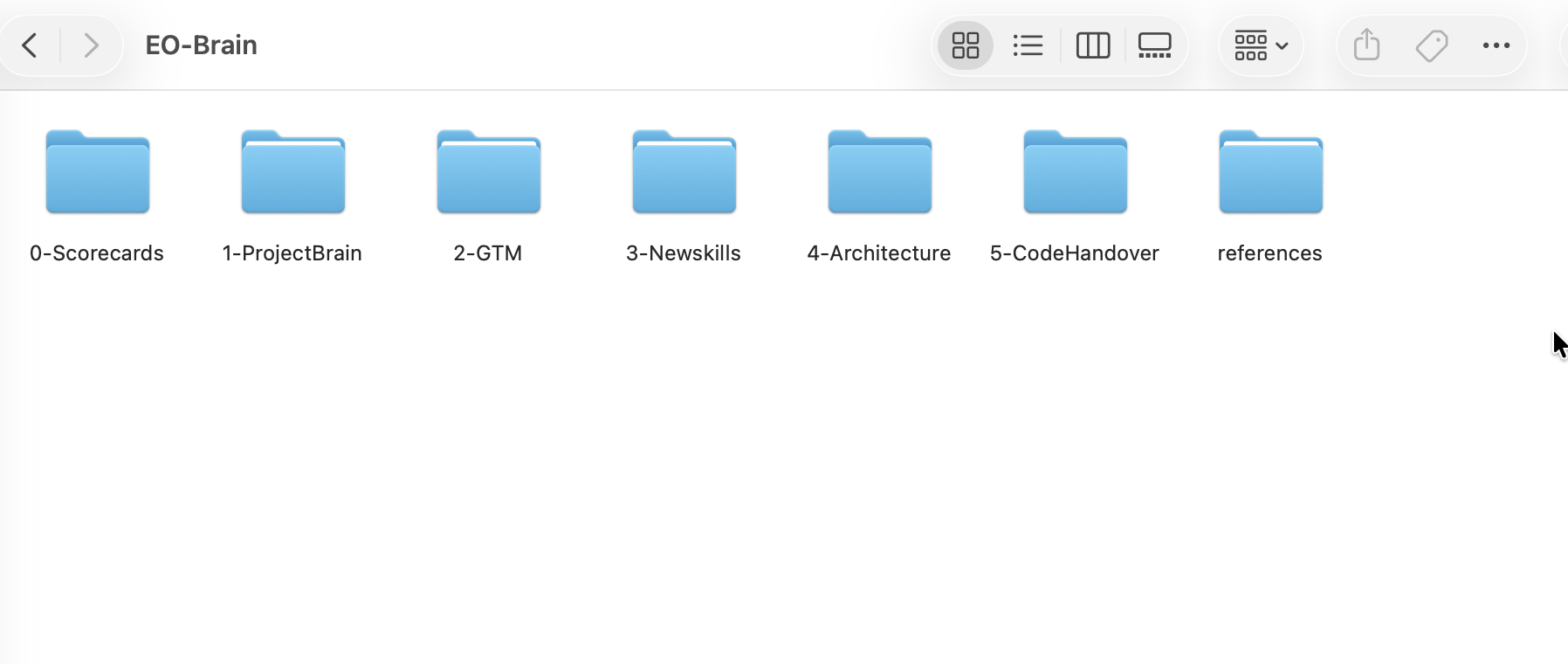
0-Scorecards, 1-ProjectBrain, 2-GTM, 3-Newskills, 4-Architecture, 5-CodeHandover, and a references folder beside them. Boring on purpose, and the boredom is load-bearing.
Each number is a station on an assembly line. Raw evaluation lands at 0. The client's context distils at 1. Go-to-market artifacts accumulate at 2. Skills extracted from this engagement wait at 3 for promotion into the permanent library. Architecture decisions sit at 4, and the finished handover leaves from 5.
Because the stations are numbered, the state of the project is legible with zero explanation. An agent picking up the build knows where the inputs are and where its output belongs. So does a human joining mid-engagement. Nobody asks where anything goes, and that silence is the point.
The two failure modes, priced
Context stuffed into folders. Every new session starts ignorant, so someone re-explains the company to a machine, daily. I have watched teams burn hours a week on this and file it under prompting skill. It is neither prompting nor skill; it is a filing error with a payroll cost.
Variables stuffed into context. Last engagement's leftovers contaminate this one. The agent confidently applies March's pricing to August's client, and nobody can say why, because the why is buried in a skill that should never have contained a number with an expiry date. The quiet, compounding mistake, same species as the subscription arithmetic nobody line-items.
The thirty-minute setup
This is the whole practice, and it fits in half an hour.
- Write the context once. Who you are, your standards, your method. Put it in project instructions and skills. If a sentence will be true next quarter, it goes here.
- Number the stations. Start with three: 0-Inputs, 1-Working, 2-Out. Add stations when the work genuinely has more stages, and never before.
- Route by one question. True next quarter goes to context. True for this engagement only goes to a numbered folder.
- Promote at the end. When an engagement teaches you something permanent, move it from the folder into a skill. Station 3 on my chart exists precisely for that promotion queue.
What we admit
This discipline is unglamorous, and the demo without it looks identical for the first week. The divergence shows up in week three, when the undisciplined setup starts contradicting itself and the disciplined one starts compounding.
The numbering scheme is also a convention, and conventions only pay when everyone honours them. One teammate who dumps files at the root can undo the legibility for everyone, silicon included. The fix is social, a one-line team rule, and no tool will enforce it for you.
Our receipts
The screenshot is from a live client build inside an architecture that has shipped 10 revenue MicroSaaS and 10 operating systems, each demoable on a fifteen-minute call. Every engagement runs this same station pattern, which is how an AI-native revenue engine hands over cleanly instead of ending in an archaeology project.
Where to start today
Open your messiest active project. Make three folders: 0-Inputs, 1-Working, 2-Out, and move every file into one of them. Then take the paragraph you keep pasting into chats and move it into project instructions, permanently.
Thirty minutes. The next session you open will already feel like a different tool.
Frequently asked questions
Do files and folders still matter in Claude Cowork?
What goes in Claude skills versus project folders?
What happens when context and work files get mixed up?
Score your org before you change it.
The free AI-Native Readiness diagnostic scores your organization across six dimensions in about ten minutes, and hands you a 90-day action plan.
Take the free diagnostic