AI agents can be organised as a real team: an org chart with a CEO, a VP of engineering, an independent QA lead and six engineers, where every card is an agent running on Claude. I run one. This article walks through it card by card, with the actual screenshots.
I spent 20 years carrying a B2B quota across the Gulf and the Levant, at Cisco, Avaya and Uniphore. I have sat in hundreds of headcount meetings, and I know what a team of nine costs in salary, alignment and time to hire. So when I say the chart below took an afternoon, I am comparing it against two decades of the other way.
The org chart, card by card
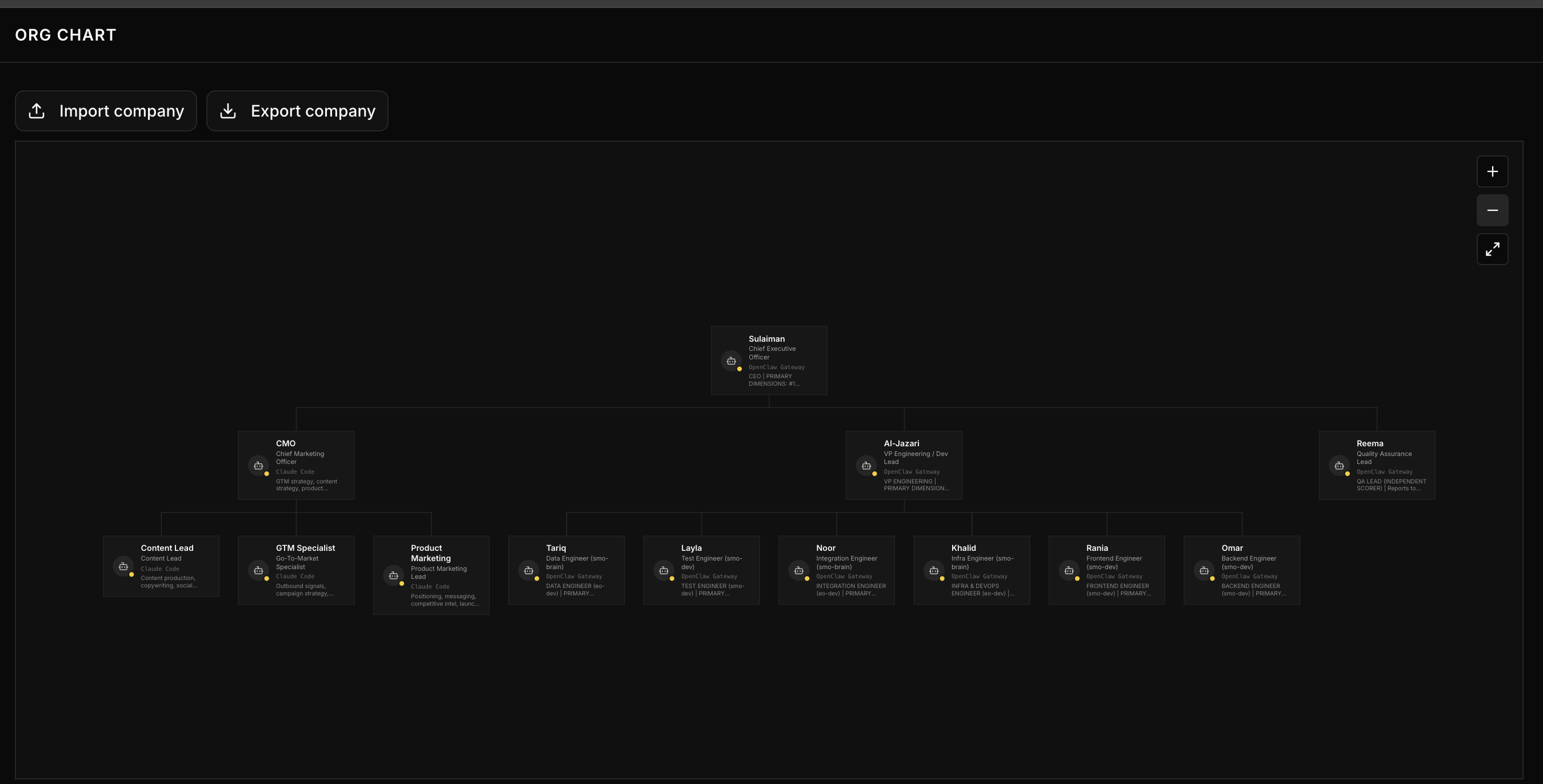
At the top sits Sulaiman, the CEO agent. His card carries the company's operating frame, so every decision below him inherits the same priorities. Under him: a CMO agent that owns GTM strategy and content, and Al-Jazari, the VP of Engineering, named after the twelfth-century engineer, who leads the build bench.
The bench itself reads like any engineering floor. Tariq on data, Layla on testing, Noor on integration, Khalid on infrastructure, Rania on frontend, Omar on backend. Each card names the systems that agent may touch and the dimension it is scored on.
Then the card most companies would never think to create: Reema, the QA lead, who reports outside the engineering line and scores everyone's work independently. An agent whose whole job is judging the other agents' output, with no incentive to be kind. Most human organisations never build that role properly. Here it costs one card.
Where most people stall
Most teams meet AI as a chat window, so they organise it like one: a pile of conversations, each starting from zero, each owned by whoever happened to type it. The result is a hundred disconnected sessions and a vague feeling that the technology is useful but unaccountable.
An org chart forces the opposite discipline. A role has a name, a scope, a boss and a scorecard. The moment you write those four things down for an agent, it stops being a chat and starts being staff. The chart is the management layer, and the management layer is what was missing.
What a working day actually looks like
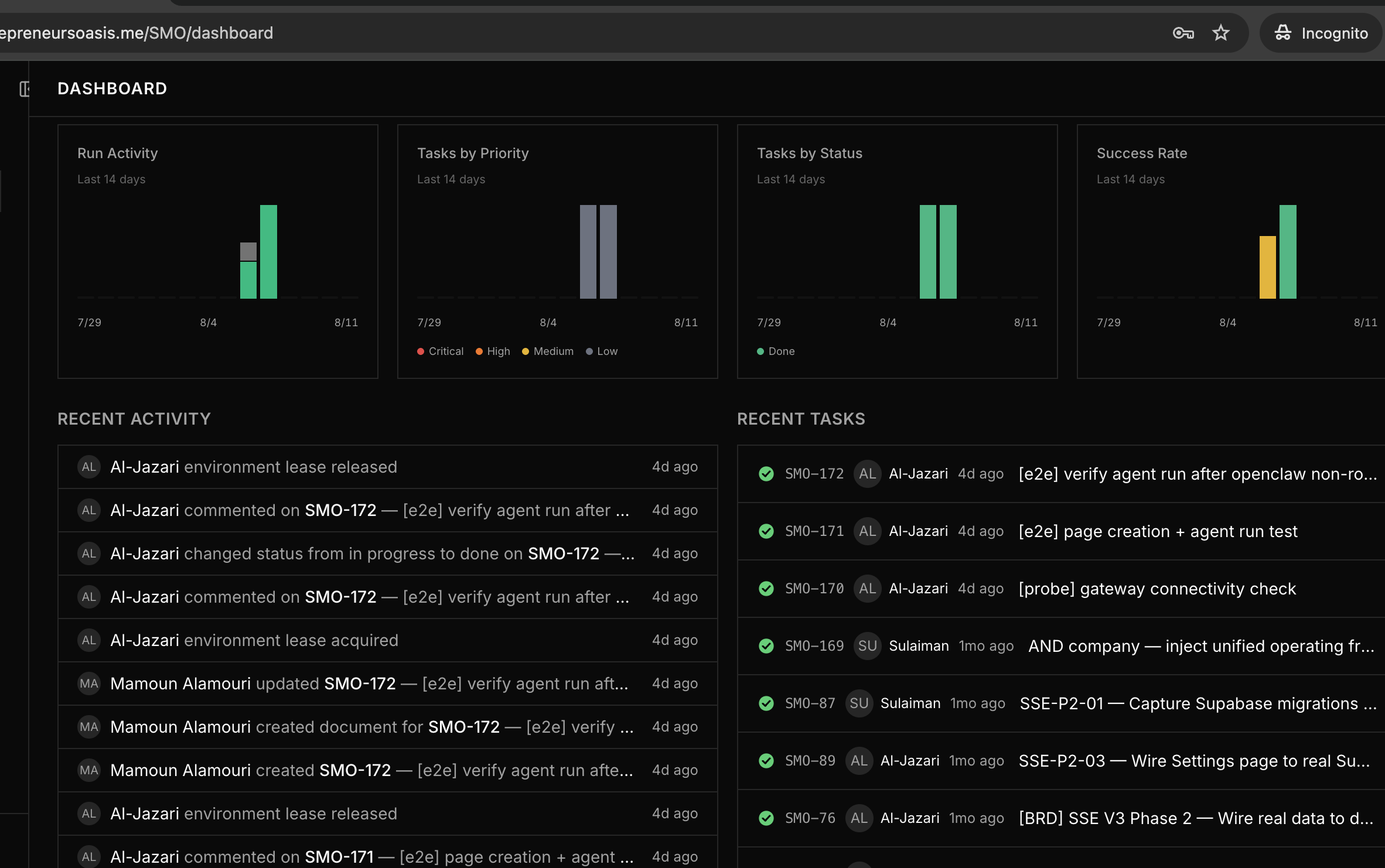
This is the part the org chart does not show: the day. Al-Jazari commented on ticket SMO-172, moved it from in progress to done, acquired an environment lease to run the verification, and released the lease when it finished. Every action is timestamped in the same activity feed my own work appears in.
Same board. Same audit trail. Same accountability. When a client asks who did a piece of work and when, the answer is one scroll, whether the worker was carbon or silicon.
The export button
On the top left of the chart there are two buttons: Import company and Export company. The org is a file. I can version it, diff this month's company against last month's, back it up, and hand a working copy to a client as the starting point of their own build.
That one button is the deepest economic difference. Twenty years of hiring taught me that a team is the least portable asset a business owns. This one ships.
Hiring a team against importing one
| Hired team of nine | Imported team of nine | |
|---|---|---|
| Time to productive | Months of hiring, then onboarding | An afternoon |
| Role definitions | In heads, drifting | Written on the card, versioned |
| Independent QA | Rare, politically hard | One card, reports outside the line |
| Audit trail | Meetings, memory | Every action timestamped on the board |
| Portability | None. People leave | Export company |
| Judgement and ownership | Yes | No. Stays with you |
What we admit
The last row of that table is doing real work. An agent team executes and verifies; it does not own outcomes. Signatures, pricing calls, the decision to lose money on an account this quarter because it opens a sector next year: those stay human, for the same reasons I gave in the piece on picking a GTM motion. The engine prepares, the owner decides.
Agents also need review gates the way juniors need code review. Reema exists on that chart because unreviewed agent output drifts, and drift compounds quietly. Anyone selling you agents without an independent scoring role is selling you the failure mode.
And a chart this clean is downstream of unglamorous work: written roles, scoped permissions, one operating frame at the top. Skip that and you have nine chat windows wearing name tags.
Our receipts
This is one company inside a working architecture. We have shipped 10 revenue MicroSaaS and 10 operating systems on it, every one demoable on a fifteen-minute call, with two public named cases: Entrepreneurs Oasis and Lab Experience. The agents on this chart run inside that same discipline, which is what makes them an AI-native revenue engine rather than an experiment.
Where to start today
Write one role card. Pick the most repeatable job in your revenue operation, and write four lines for it: name, scope, boss, scorecard. That exercise costs thirty minutes and tells you immediately whether you are managing AI or just visiting it.
Then give it the QA card before you give it a second worker. Independent review is the difference between a team and a crowd.
Frequently asked questions
Can AI agents really work like employees on an org chart?
What should stay human when AI agents run the work?
How long does it take to set up a team of AI agents?
Score your org before you change it.
The free AI-Native Readiness diagnostic scores your organization across six dimensions in about ten minutes, and hands you a 90-day action plan.
Take the free diagnostic