At 1:58 AM, three AI agents researched API changes across fifteen platforms, wrote a delta report and ran quality checks on their own output. Nobody prompted them; a schedule fired, the way a schedule fires payroll. That is the difference between prompting and an operating system, and this article shows it with the real screenshots.
I say this as someone who was good at prompting and enjoyed it. Prompt engineering is a hobby. A productive one, a gateway one, but a hobby, because its ceiling is your own attention. This piece is about what sits above that ceiling.
Anatomy of the 1:58 AM run
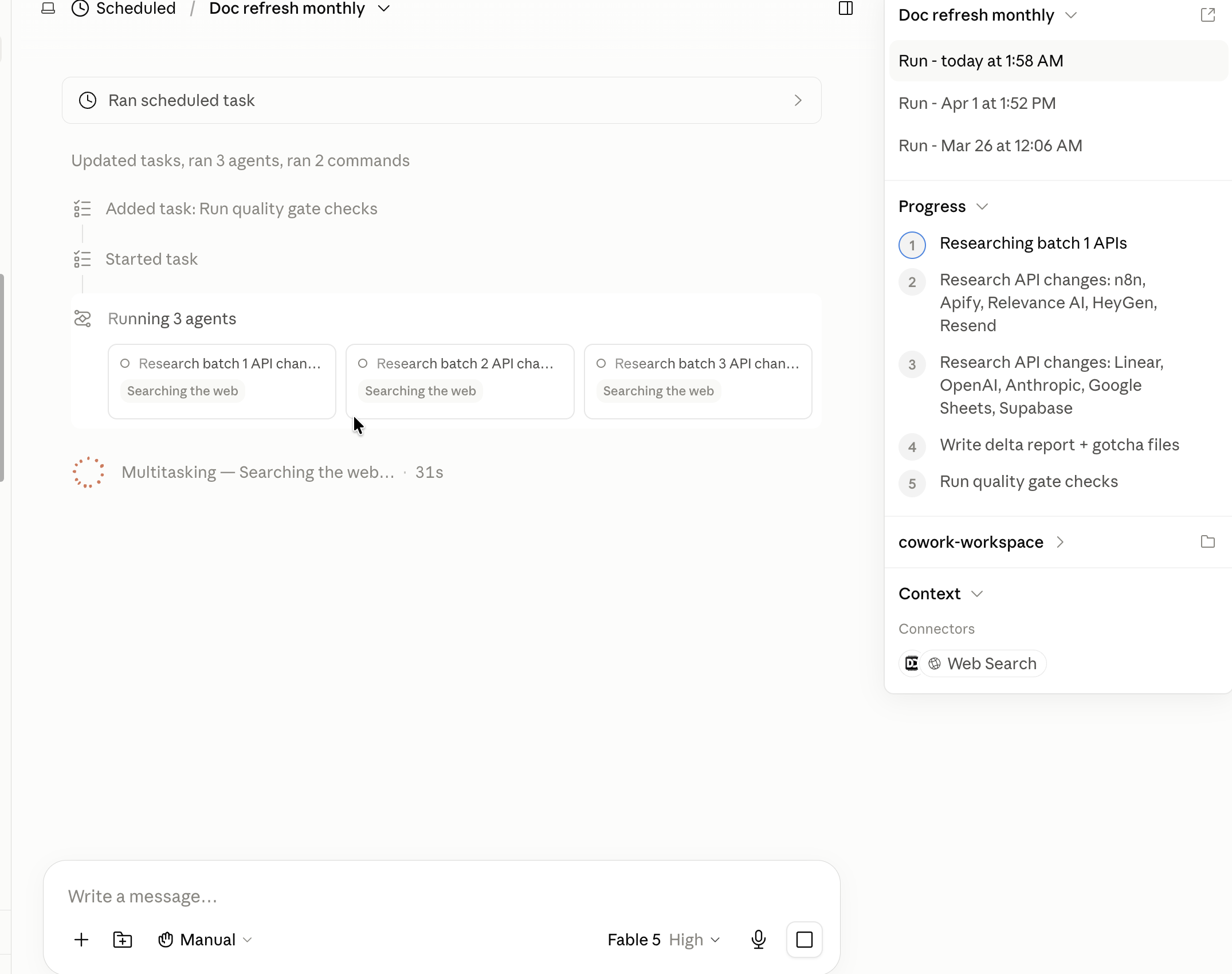
The job is a monthly documentation refresh. Fifteen APIs my operation depends on: n8n, Anthropic, Supabase, Linear, OpenAI and the rest. The run splits them into three batches, one agent per batch, working in parallel.
Read the plan on the right of the frame. Steps one to three are research. Step four writes the delta report and the gotcha files. Step five runs quality gate checks on everything the first four steps produced. The system checks its own work before I ever see it, and a run that fails its gates does not get to call itself finished.
I was asleep. That sentence is the entire pitch, and the timestamp makes it a receipt instead of a slogan.
A request against a standing instruction
A prompt is a request. You are present, you phrase it well, you wait, you carry the answer somewhere yourself. Do it brilliantly and you have still done it manually, and tomorrow you will do it again.
A standing instruction lives in the system. The context, the standards and the quality gates are written once. The calendar supplies the trigger. Work arrives finished, and your role moves from doing to reviewing. Your attention stops being the engine and becomes the court of appeal.
Once you see that split, you can price it. Every weekly report a person assembles by hand is attention spent on something a standing instruction would do at 2 AM for nothing.
The standing-jobs board
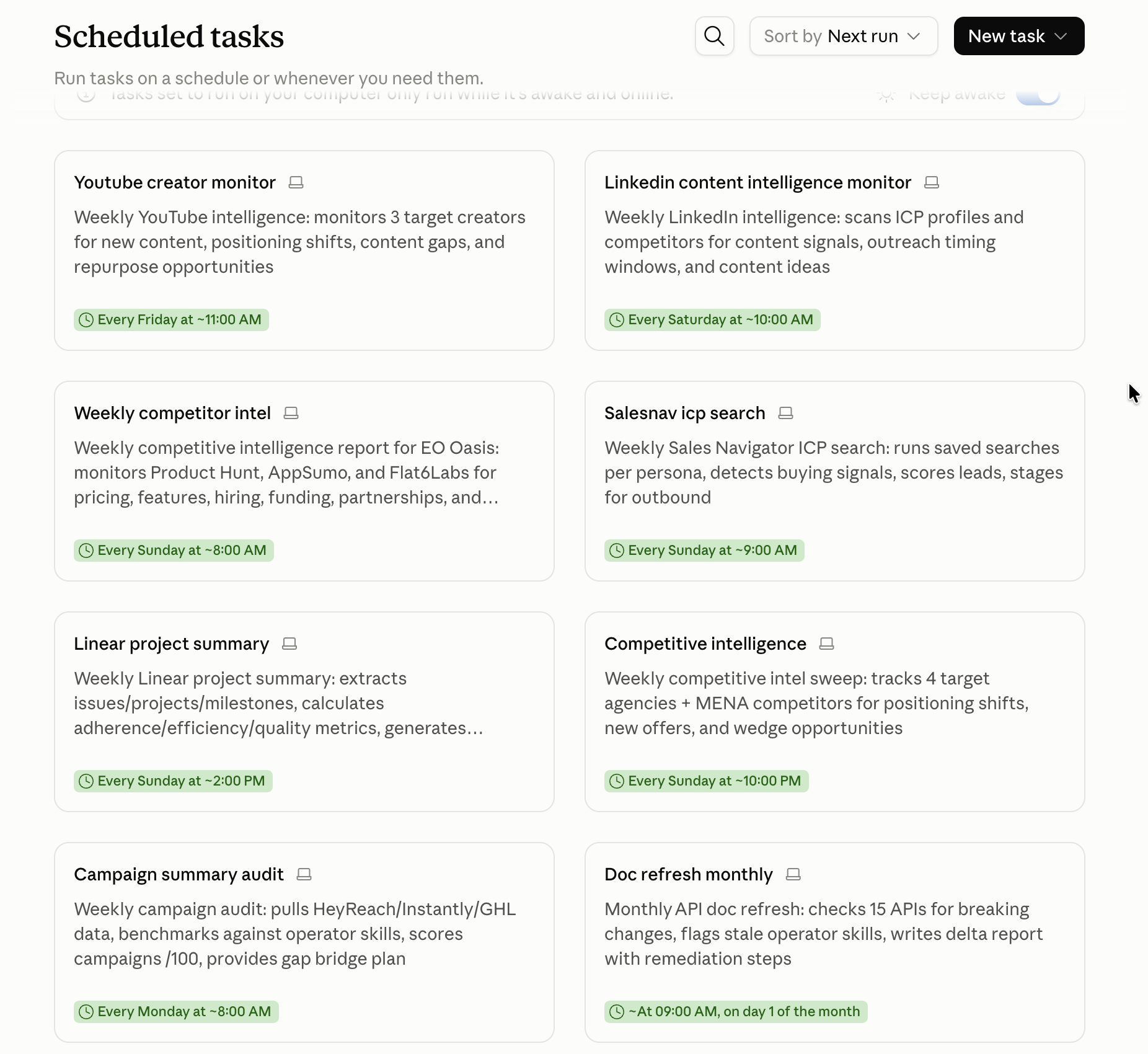
This is the board the 1:58 AM run came from. Eight standing jobs, every week: a YouTube monitor across three target creators, a LinkedIn intelligence sweep of ICP profiles, competitor tracking across Product Hunt and AppSumo, a Sales Navigator ICP search that scores leads before Sunday breakfast, a Linear project summary, a campaign audit every Monday at 8, and the monthly doc refresh you just watched run.
Before this board, each of those was either an afternoon of skilled attention or a thing that quietly did not happen. Competitive intelligence is the honest example: everyone agrees it matters, and almost nobody does it weekly, because no one has a spare analyst. A standing job does not need a spare analyst.
How to design a standing job
Every job on that board has the same five parts, and the five parts are the checklist for building your own.
- A trigger. A day and an hour. If it needs a human to remember it, it is a chore wearing a costume.
- A scope. Three creators. Four agencies. Fifteen APIs. Unbounded scope makes unfinishable jobs.
- Named sources. Where the agent looks, written into the job, so two runs are comparable.
- An output contract. A report, a scored list, a delta file. The job produces an artifact, never a vibe.
- A quality gate. The step that checks the work before you see it. This is the one most people skip, and the one that separates a system from a toy.
Write those five lines for one job and you have left prompting. The words in the box matter less than the fact that nobody has to type them again.
What we admit
Scheduling multiplies whatever you point it at, including waste. A vague job runs vaguely forever, and a report nobody reads gets industrialised like anything else. The board earns its keep only if every artifact has a reader and a decision attached.
Some work should never be scheduled. Anything touching an offer you have not settled, a message going to a named human, or a judgement about money stays on the reviewed path, for the reasons laid out in the rent-or-own arithmetic: the expensive mistakes are the quiet, compounding ones.
And the first week of any new standing job produces mediocre output. That is the tuition. You tighten the scope, name better sources, raise the gate, and by week three the artifact is better than what a distracted human produced, because it is never distracted.
Our receipts
This board is one surface of a larger build: 10 revenue MicroSaaS and 10 operating systems shipped on the same architecture, each demoable on a fifteen-minute call. The standing jobs are what an AI-native revenue engine looks like when nobody is watching it, which is most of the time.
Where to start today
Pick the report you assemble by hand every week and hate. Write the five lines for it: trigger, scope, sources, output contract, quality gate. Schedule it for a morning you are asleep.
Then judge it the way you would judge a new analyst: on the third week's work, on artifacts, with your name nowhere in the production of it.
Frequently asked questions
What is the difference between prompt engineering and an AI operating system?
What makes a good scheduled AI task?
What should never run on a schedule?
Score your org before you change it.
The free AI-Native Readiness diagnostic scores your organization across six dimensions in about ten minutes, and hands you a 90-day action plan.
Take the free diagnostic