There are four levels of Claude for business: prompts, skills, plugins, and marketplaces. Most teams stop at the first, the compounding starts at the third, and the economics change at the fourth. This is the whole ladder, with the real screenshots of a company running on the top rung.
The ladder, level by level
A prompt solves today's task and is gone by tomorrow. Useful, unownable, and the level where the entire market conversation is stuck.
A skill is a prompt that survived. Written once, named, versioned, invoked the same way every time by anyone on the team. The unit of never repeating yourself.
A plugin is skills organised into a method: a numbered chain with an order, refusal rules for bad input, and quality gates. A methodology you can install.
A marketplace is how plugins move. Install by name, update like an app, one canonical version for every machine and every agent. Distribution for methods.
What the roster of a plugin company looks like
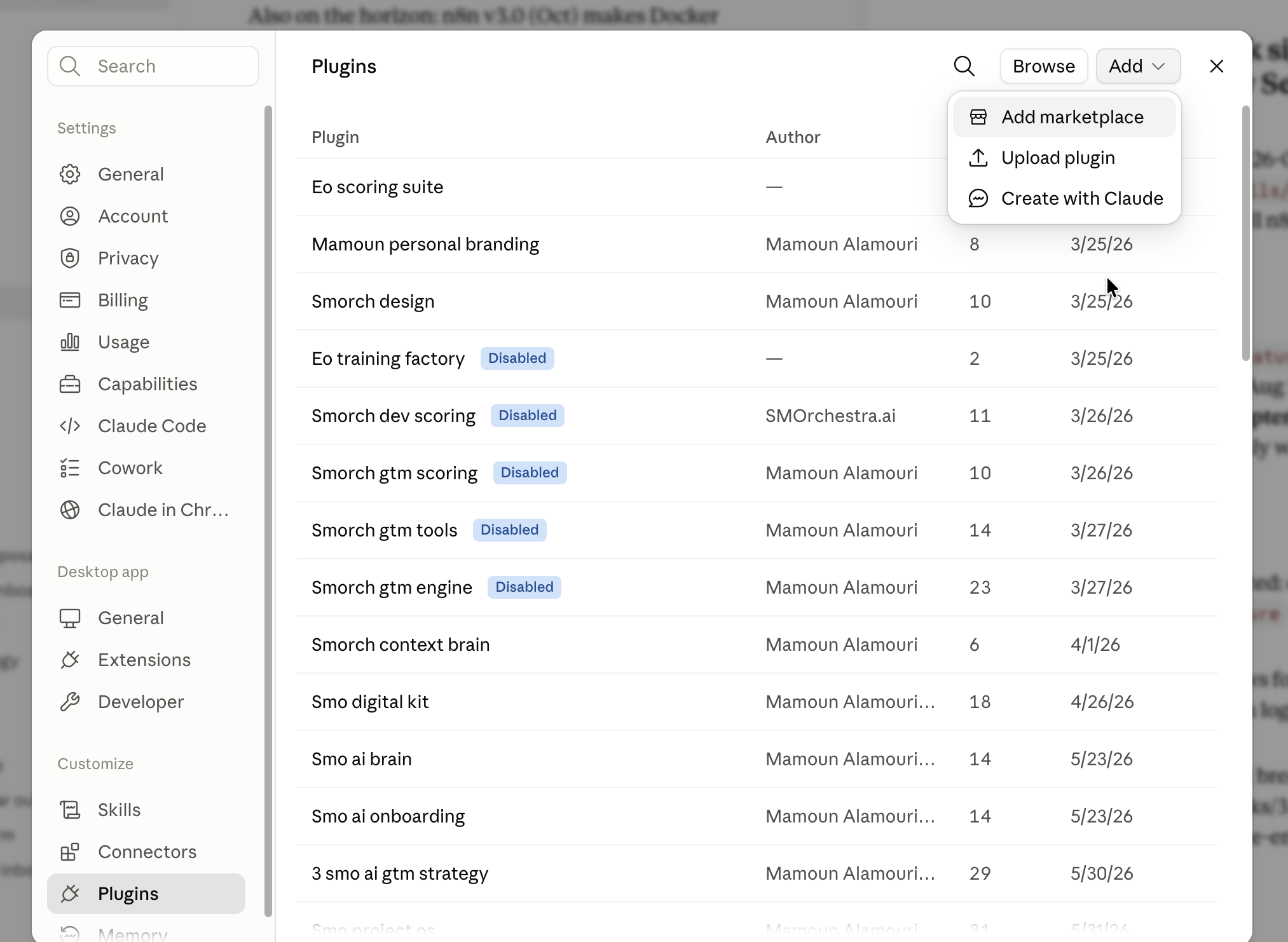
Read the numbers down the right side of that panel. 8, 10, 11, 14, 18, 23, 29. Every one is a skill inside a plugin, which means every one is a piece of method that stopped living in somebody's head.
The names matter as much as the counts. Onboarding, brain, GTM strategy, scoring, design. That list reads as the company's operating manual, decomposed into installable parts.
A plugin at version 1.5.0
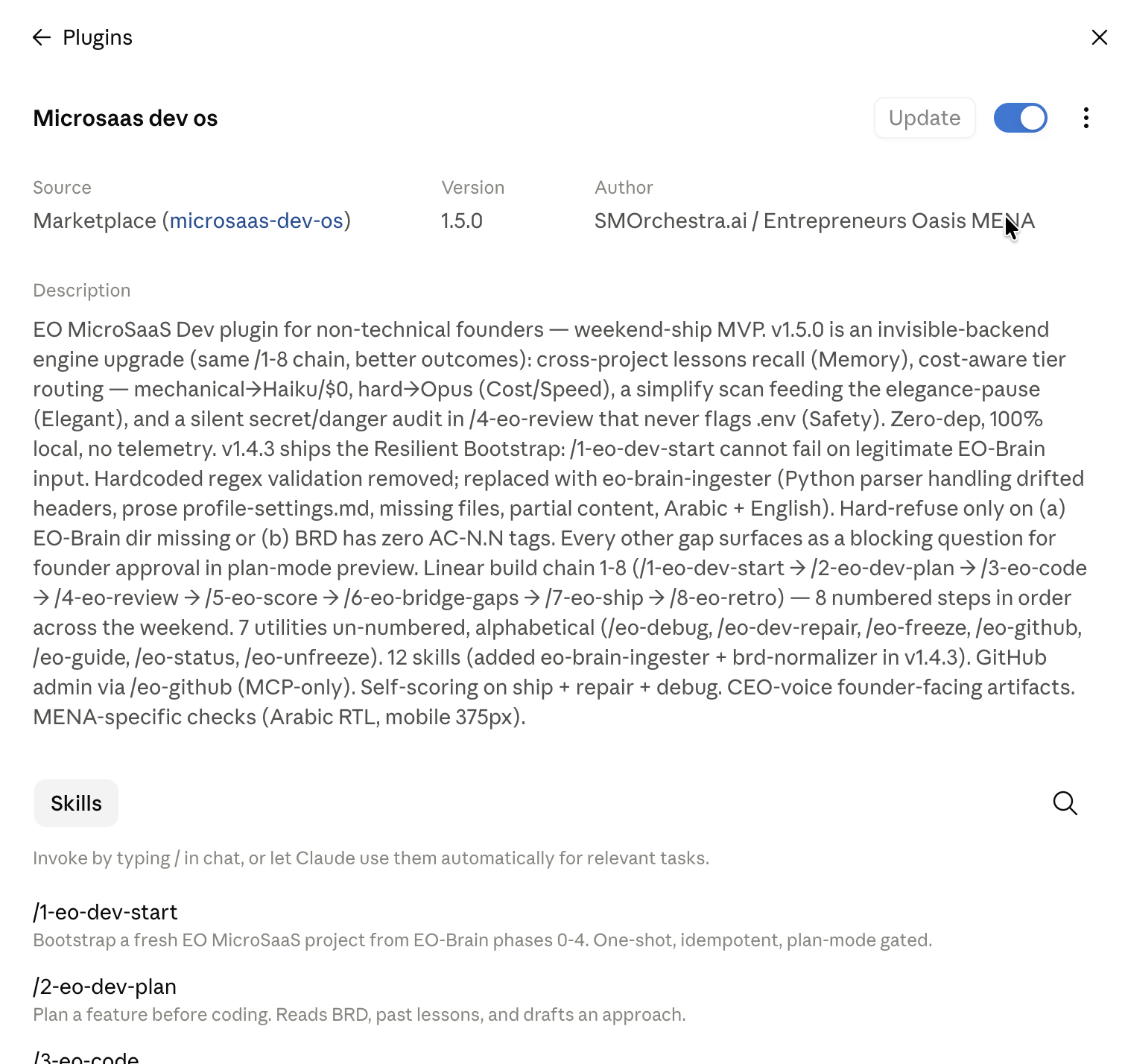
This is what the third rung looks like up close. MicroSaaS Dev OS, version 1.5.0, with release notes that read like software because it is software: cost-aware model routing added in one release, a resilient bootstrap in another, a silent secrets audit in a third.
Look at the chain: eight numbered steps from project start to ship, seven utilities beside them, twelve skills underneath. And the part I respect most in any method, machine or human: it refuses. Bad input gets a hard stop and a named reason, because a method that accepts anything produces anything.
A junior can run this and get a senior's process. An agent can run it and get the same. That sentence is the plugin economy in one line.
Distribution is a marketplace
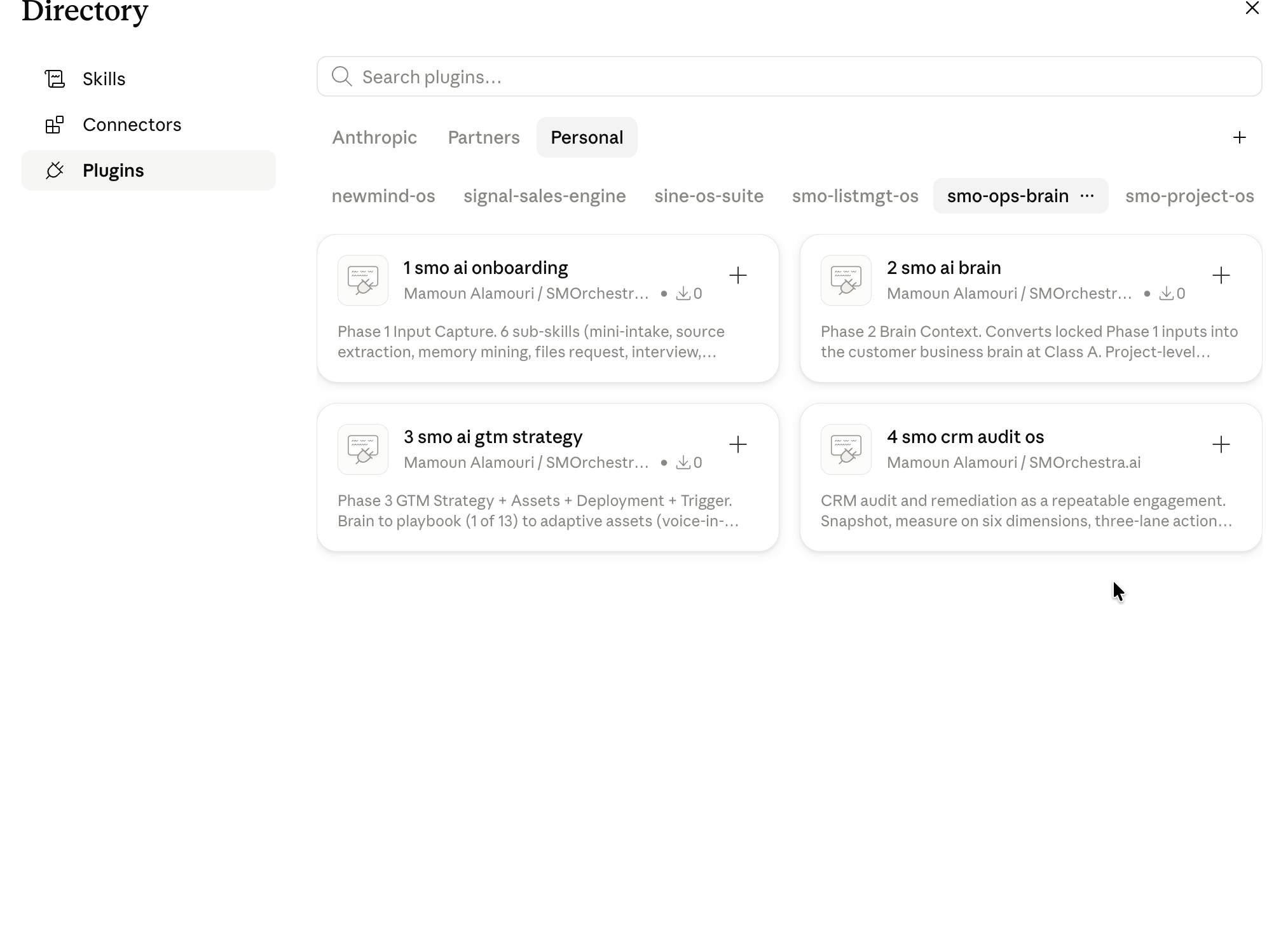
I watched teams share their AI workflows as zip files in WhatsApp groups, and I understood the instinct while wincing at the method. A zip file is where a method goes to die: no version, no update path, no way to know who is running last quarter's mistakes.
The screenshot is the alternative. Seven private marketplaces, plugins numbered in sequence inside each. When I fix a skill, every machine and every agent running it inherits the fix the way your phone inherits an app update. My Signal Sales Engine ships as eight plugins carrying 118 skills through exactly this channel.
The four levels, priced
| Level | Who owns it | It dies when | Does it compound? |
|---|---|---|---|
| Prompt | Whoever typed it | The chat closes | No |
| Skill | The team | Nobody maintains it | Slowly |
| Plugin | The company | The method itself is wrong | Yes. Every lesson becomes a version bump |
| Marketplace | The company | You stop shipping | Yes, across every machine and client at once |
The regional conversation about Claude for business is stuck on which model and which licence. Wrong floor of the building. Model access is rented and identical for everyone in Riyadh, Dubai and everywhere else. The plugin layer is owned, and owned layers are where margins live, the same arithmetic as the rent-or-own split applied to your own methods.
What we admit
Most prompts should stay prompts. Promote something up the ladder only after it has repeated three times; a plugin built for a job that happens twice a year is bureaucracy with version numbers.
Plugins are maintained software, and maintenance is the cost nobody quotes. Fifteen APIs shift under my stack, which is why a scheduled job checks them monthly and flags stale skills. Owning methods means owning their upkeep.
And the ladder does not make judgement installable. A plugin encodes how we work; deciding whether the work is right for this client, this quarter, stays with a person whose name is on the outcome.
Our receipts
10 revenue MicroSaaS and 10 operating systems shipped on this architecture, every one demoable on a fifteen-minute call. The Signal Sales Engine's published architecture is 8 plugins and 118 skills, with three gates enforced in CI rather than by convention. The method that builds all of it is itself a plugin, at version 1.5.0 and counting, which is the strongest claim I can make for the approach: we run our own company on the ladder we are describing.
Where to start today
Find the prompt your team has retyped most this month. Promote it to a skill: name it, write it once, put it where everyone invokes the same version.
When you have five skills that belong to one job, you have a plugin waiting to be assembled. When you have two plugins, stop sharing files and stand up the marketplace. The ladder climbs itself once the first rung is real.
Frequently asked questions
What is the difference between a Claude skill and a Claude plugin?
Why use a plugin marketplace instead of sharing files?
When is building a plugin premature?
See how the layer installs.
This is a working system we build, operate for 90 days, then transfer. See the full install.
Explore the engine