SaaS is not dying. Renting generic software is. The obituary keeps naming the wrong corpse, and companies that read it wrong are about to cancel the tools they should keep and renew the ones bleeding them.
Every week another post declares the death of SaaS, and every week a procurement team somewhere uses it to justify the wrong decision. The claim needs sorting, not repeating. Here is the full sort: what dies, what survives, and what takes the money.
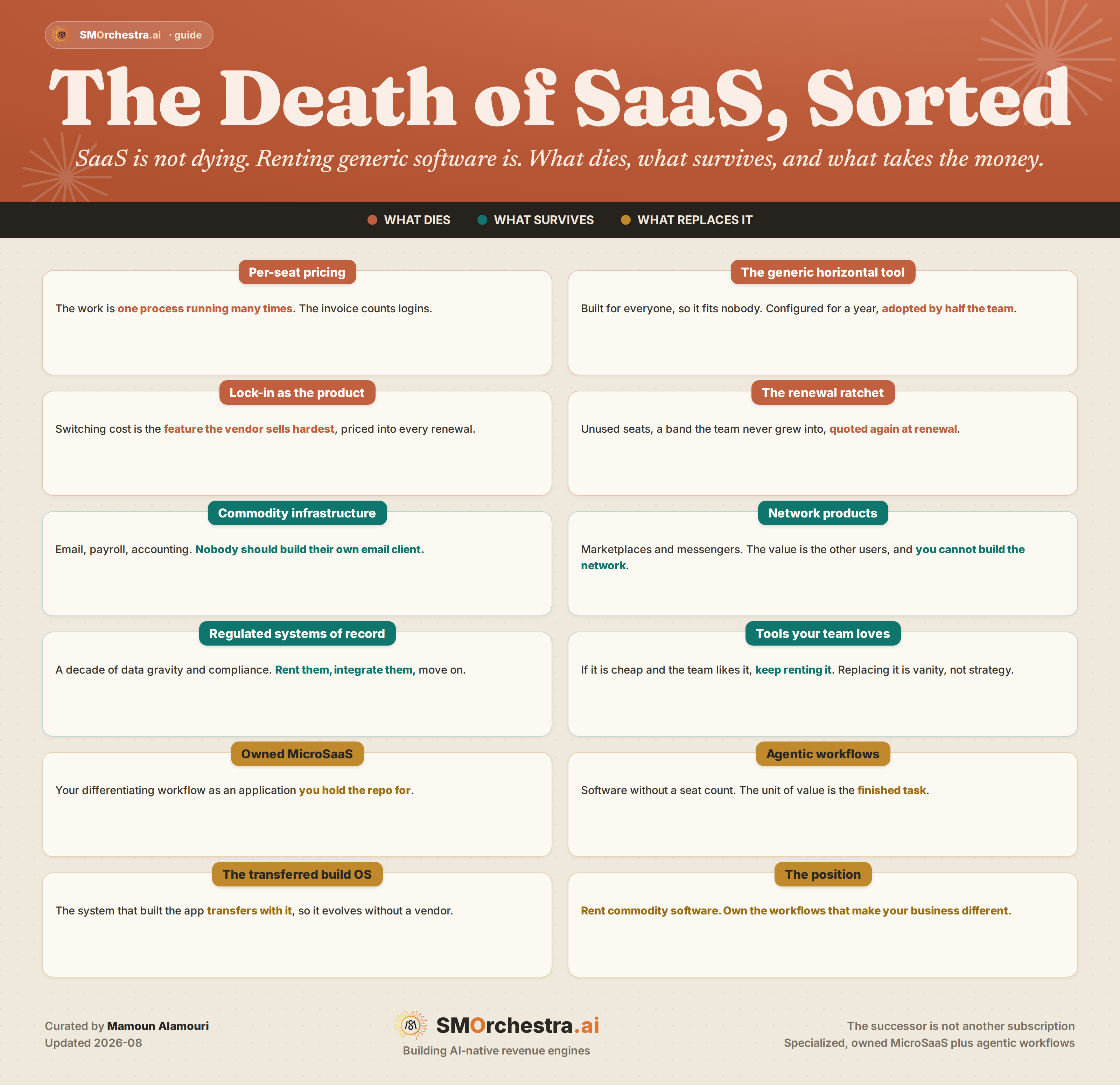
What dies: the rent-extraction layer
Four things are genuinely dying, and none of them is software.
Per-seat pricing on repetitive work. When the work is one process running many times, an invoice that counts logins is billing you for headcount the process no longer needs. The pricing model made sense when humans were the process. They are not anymore.
Lock-in as the product. Switching cost is the feature the vendor sells hardest, and it is priced into every renewal. When leaving is expensive by design, the renewal conversation is not a negotiation.
The generic horizontal tool. Built for everyone, so it fits nobody. You configure it for a year and half the team adopts it. All that configuration effort was your process trying to escape the tool.
The renewal ratchet. Unused seats, a pricing band the team never grew into, quoted again at renewal. Finance leaders in Dubai and Riyadh have signed this invoice for years while suspecting exactly what it was.
What survives: everything the obituary gets wrong
The death-of-SaaS crowd overreaches here, and the overreach is expensive.
Commodity infrastructure survives. Email, payroll, accounting. Nobody should build their own email client, and the point of owning software was never to own everything.
Network products survive. Marketplaces and messengers hold their value in the other users, and you cannot build the network. Renting access to a network is buying distribution, and that trade stays good.
Regulated systems of record survive. A decade of data gravity and compliance sits inside them. Rent them, integrate them, move on.
Tools your team loves survive. If it is cheap and the team likes it, keep renting it. Replacing a working, liked, inexpensive tool is vanity, not strategy.
What takes the money
The budget leaving the dying column does not go to new subscriptions. It goes to two things that were not practical for a mid-size business until this year.
Owned MicroSaaS. Your differentiating workflow as an application you hold the repository for. Not a platform, not a suite: the one workflow that makes your business different, built to fit it exactly. We have shipped ten of these as revenue products, and every one demos live inside fifteen minutes.
Agentic workflows. Software without a seat count, where the unit of value is the finished task. The invoice counts outcomes, and the ceiling on throughput stops being your headcount.
The system that builds these matters as much as the software. Our builds transfer with the operating system that built them, so the application keeps evolving after handover without a vendor in the loop.
The position, in one line
Rent commodity software. Own the workflows that make your business different.
That is the whole sort. Run your subscription list against it this week: mark each line dies, survives, or replace-with-owned. The list usually splits fast, and the money it frees is the budget for the first workflow you own.
One idea like this lands every Tuesday in The Transfer, our short 3-1-1 newsletter from a live AI-native build.
Frequently asked questions
Is SaaS actually dying?
What should replace the SaaS my company cancels?
How do I decide which subscriptions to keep and which to replace?
Sort your stack, then own the first workflow.
Revenue MicroSaaS is the owned column of this article as a service: your differentiating workflow, built, operated for 90 days, then transferred with the system that built it.
See how the transfer works