How to Use SMS Reminders for Bookings and Sales Follow-Ups
In a world buzzing with notifications, SMS reminders for bookings and sales follow-ups have a unique power: they cut through the noise. Unlike channels that rely on an internet connection, SMS lands directly on every mobile phone, making it the perfect supporting tool for critical confirmations, appointment reminders, and alerts that cannot be missed. When integrated into a broader omnichannel system, SMS becomes a high-impact channel for reducing no-shows and re-engaging leads.
This guide focuses on using SMS strategically within an automated follow-up system for clinics and sales teams. We'll explore how it complements channels like WhatsApp and email to ensure your most important messages are always seen.
Why SMS is a Critical Supporting Channel in Your Follow-Up System

While channels like WhatsApp and email are ideal for rich, conversational messaging, they have a key vulnerability: they require a stable internet connection and depend on users having app notifications enabled. SMS, on the other hand, only needs a basic cellular signal, giving it a universal reach that covers every device, from the latest smartphone to a simple feature phone. This makes it an essential component of any clinic's or sales team's communication strategy.
Think of SMS not as a primary conversational tool, but as the reliable backbone of your follow-up workflow. It’s your safety net. When an email is ignored or a WhatsApp message goes unread, a direct SMS ensures your client or lead receives the essential information.
The Universal Reach of SMS
For clinics, sales teams, and any service-based business, this level of reliability is invaluable. A single automated SMS reminder can be the difference between a filled appointment and a costly no-show, or the nudge that revives a stalled sales conversation. Its simplicity is its strength.
Data supports this. In regions like the Middle East and Africa, where mobile internet can be inconsistent, a significant portion of the population relies on SMS for business communications. This makes it non-negotiable for appointment reminders and critical follow-ups, especially for businesses like clinics in the GCC. It’s why AI-driven platforms like SMOrchestra focus on integrating SMS into automated workflows that send reminders in both Arabic and English, dramatically reducing no-show rates.
Comparing Follow-Up Channels: When to Use SMS
To understand the strategic value of SMS, it's helpful to see how it compares to other channels. Each has a specific role, and SMS fills a critical gap where immediate, guaranteed delivery is paramount.
The most effective strategy integrates SMS into a larger, automated system. When used with platforms like the best CRM for small business, SMS becomes a powerful trigger in an intelligent communication sequence that drives action.
Designing Effective SMS Reminder and Follow-Up Sequences
An effective SMS sequence is built on three pillars: clarity, timing, and a simple next step. The goal isn't just to send a notification; it's to elicit a specific, trackable response that moves a client or lead forward in your process. This section provides a practical playbook for building SMS workflows that work for clinics and appointment-based businesses.
The Anatomy of a High-Performing SMS Message
Every effective SMS reminder or follow-up is built from the same core components. Use this as a checklist before launching your sequence.
- Personalization: Always use the client's name. A message addressed to "Fatima" feels personal, while a generic alert feels like spam.
- Core Details: State the essential information clearly: appointment date, time, and location (e.g., "with Dr. Amara").
- Sender Identification: Include your clinic or business name so the recipient immediately knows who is contacting them.
- A Clear Call-to-Action (CTA): This is the most critical element. Tell them exactly what to do. Simple, direct instructions like "Reply C to Confirm" or "Reply R to Reschedule" are most effective.
When these elements are combined, your SMS becomes an interactive tool that helps manage your schedule and reduce administrative overhead.
Proven SMS Templates for Key Scenarios
Here are battle-tested templates for critical touchpoints in a booking and follow-up workflow. They are designed to be direct and effective.
1. Instant Booking Confirmation
Purpose: To provide immediate reassurance that the appointment is locked in.
Timing: Send immediately after a booking is made.
Template: "Hi [Client Name], your appointment with [Clinic Name] is confirmed for [Date] at [Time]. We look forward to seeing you! To reschedule, please call [Phone Number]."
2. The 24-Hour Pre-Appointment Reminder
Purpose: To significantly reduce no-shows by requiring an action.
Timing: Send 24 hours before the scheduled appointment.
Template: "Hi [Client Name], a friendly reminder of your appointment tomorrow at [Time] with [Clinic Name]. Please reply C to confirm your attendance. Thank you!"
3. The Post-Consultation Follow-Up
Purpose: To gather valuable feedback or guide a lead to the next step.
Timing: Send 1-2 hours after the appointment or consultation.
Template: "Hi [Client Name], thank you for visiting [Clinic Name] today. We value your feedback! Could you take 30 seconds to share your experience here: [Link]?"
Personalization and Bilingual Messaging
In diverse markets like the MENA region, a one-size-fits-all message is ineffective. Communicating in a client's preferred language is a simple yet powerful way to boost engagement.
An intelligent system can automatically detect a client's language preference from your CRM and send messages in either English or Arabic.
Bilingual Example (Confirmation):
"Hi [Client Name], your appointment with [Clinic Name] is confirmed for [Date] at [Time]. Reply C to confirm.
مرحباً [اسم العميل]، تم تأكيد موعدك مع [اسم العيادة] في [التاريخ] الساعة [الوقت]. الرجاء الرد بـ C للتأكيد."
By connecting your SMS platform to your CRM, you can automate the personalization of names, appointment times, and language. This makes messages feel relevant and drives responses. While powerful, SMS is most effective when combined with other channels. For more on messaging in this market, see our guide on WhatsApp follow-up messages for MENA sales teams.
Weaving SMS Into Your Omnichannel Follow-Up Strategy
SMS reminders are effective on their own, but they become a strategic asset when integrated into a broader omnichannel system. Instead of just sending messages, you build an intelligent communication engine that automatically selects the right channel at the right time.
This approach is centered on smart channel escalation: a carefully designed workflow that ensures your message gets through by increasing the directness of the follow-up based on the client's response (or lack thereof).
The Art of Channel Escalation
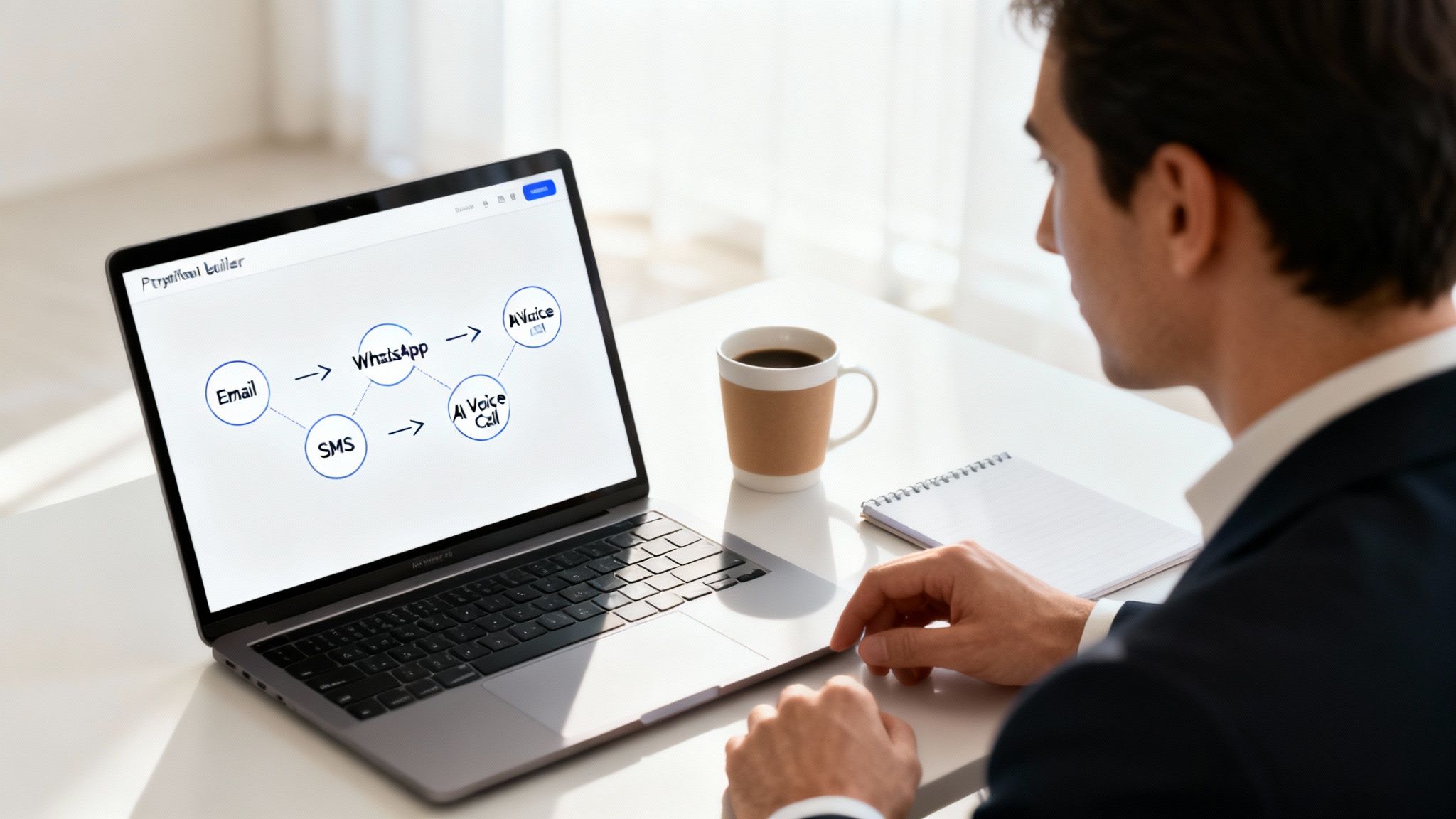
Imagine your communication channels—email, WhatsApp, SMS, and AI-powered calls—as layers in a system designed to guarantee contact. An omnichannel platform doesn't send the same message everywhere. It escalates the urgency intelligently.
This sequence ensures you never over-communicate but also never let a valuable lead or appointment slip away.
- Step 1: The Informational Start (Email): The first touchpoint can be a detailed email containing appointment information or a sales proposal. It's ideal for rich content but has the lowest open rate.
- Step 2: The Conversational Nudge (WhatsApp): If the email is unopened after a set time (e.g., 6 hours), the system can automatically send a friendly WhatsApp message. This feels more personal and has higher engagement in the MENA region.
- Step 3: The Unmissable Alert (SMS): If there's still no response, the system escalates to SMS. This is your guaranteed touchpoint—a direct, concise message that cuts through the noise and delivers the essential reminder.
This layered strategy ensures critical information, like a 24-hour appointment reminder, is seen. An automated platform like SMOrchestra executes this entire sequence hands-free, turning your follow-up process into a reliable engine for your clinic or sales team. To learn how this fits into a broader strategy, review our guide on creating multi-channel outbound campaigns for MENA SMEs.
Turning a Simple Response into Immediate Action
Integration also works in reverse. A simple SMS reply can trigger the next action in your workflow automatically, transforming your reminder system from a passive tool into an interactive one that accelerates your sales or booking cycle.
For instance, if a lead replies "YES" to an SMS asking if they are ready to book a consultation, the system can be configured to immediately:
- Add them to a high-priority call list for your sales team.
- Trigger an AI voice agent to call them instantly to find and book a suitable time.
- Send a follow-up WhatsApp message with a direct booking link.
This diagram illustrates a typical SMS sequence within a booking system, from confirmation to post-appointment follow-up.

Each message builds on the last, creating a frictionless communication flow that guides the client through the process.
The market validates this approach. The Middle East's Application-to-Person (A2P) Messaging Market was valued at approximately USD 3.1 billion and is growing rapidly, underscoring the critical role of SMS in business communications for healthcare, retail, and finance. In GCC countries, where SMOrchestra’s AI-driven platform is ideal, businesses rely on SMS for order confirmations and delivery updates, proving its value in enhancing the customer journey.
Measuring The True Impact Of Your SMS Reminders
Sending SMS reminders is simple; measuring their effectiveness is what separates successful systems from noisy ones. To justify the investment, you must track metrics that directly impact your clinic's schedule and your sales team's pipeline.
Forget vanity metrics like "open rates." For SMS, they are nearly 100% and thus meaningless. The crucial question is: did your message drive the desired action?
Key Performance Indicators That Matter
To measure the real impact of your SMS reminders for bookings and sales follow-ups, track KPIs tied directly to your business outcomes.
- No-Show Rate Reduction: This is the primary metric for appointment-based businesses. Calculate your baseline no-show rate before implementing SMS reminders and track the percentage decrease. A 5% reduction can significantly impact monthly revenue.
- Confirmation Rate: What percentage of clients reply "C" to confirm their appointment? A high rate provides schedule predictability and allows you to fill last-minute openings.
- Reschedule Rate: How many clients use SMS to proactively reschedule? This is a win, as it saves a booking that would have otherwise become a no-show.
- Follow-Up Conversion Rate: For sales, this KPI tracks how many leads take the next step (e.g., book a demo, reply with a question) after receiving an SMS. It measures the effectiveness of SMS in re-engaging cold leads.
- Time-to-Confirm: How quickly do clients respond to confirmation requests? A short response time indicates clear messaging and an engaged audience.
Tracking these metrics requires a system that logs responses and syncs them with your CRM or calendar. Automation platforms like SMOrchestra provide dashboards that show exactly what is working, allowing for data-driven optimization.
A/B Testing For Continuous Improvement
Once you have baseline data, begin optimizing through A/B testing. Send two slightly different message versions to small audience segments and measure which performs better.
Here are a few elements to test:
- Timing: Is a 24-hour reminder more effective than a 48-hour one? Does a final 2-hour reminder further reduce no-shows?
- Copy: Test a formal tone versus a more casual one. Does adding personalization like "Your appointment with Dr. Sara" improve confirmation rates?
- Call-to-Action (CTA): Compare a simple "Reply C to Confirm" against "Confirm here: [link]". Simpler CTAs typically win in SMS.
- Language: For bilingual audiences, test sending messages in Arabic versus English, or a mix of both, to identify which yields a higher response rate.
This data-driven approach transforms your reminder system from a simple tool into a strategic asset. The principles behind lead scoring and auto-routing in a CRM provide a useful framework for prioritizing how to act on the responses you receive.
A Guide to SMS Compliance in the MENA Region
Using SMS for business communication is about building trust. Adhering to compliance regulations in the MENA region isn't just a legal requirement; it's a way to show respect for customer privacy and build a reputable brand.
One unsolicited text can damage a customer relationship permanently. In contrast, a compliant, well-timed message reinforces professionalism and makes customers feel valued.
The Core Rules of Engagement
Navigating Application-to-Person (A2P) messaging rules in countries like the UAE and Saudi Arabia comes down to a few fundamental principles.
- Get Clear Permission (Opt-In): You must have documented consent from individuals to receive SMS from you. This should be an explicit action, like checking a box that clearly states they agree to receive SMS alerts.
- Provide an Easy Exit (Opt-Out): Every message must include a simple way to unsubscribe, such as "Reply STOP to cancel." This request must be processed automatically and instantly.
- Register Your Sender ID: In many countries, you cannot send business messages from a standard number. You must register an alphanumeric Sender ID (e.g., "MyClinic") to identify your brand, build trust, and prevent your messages from being blocked as spam.
- Mind the Clock: Sending messages late at night or during culturally sensitive times (like prayer times) is disrespectful and damages your brand. Schedule automated messages for appropriate business hours.
Understanding Local Laws and Data Privacy
SMS compliance is closely tied to the region’s data privacy regulations. For example, the UAE's Telecommunications and Digital Government Regulatory Authority (TDRA) has strict policies against unsolicited marketing. In Saudi Arabia, the Personal Data Protection Law (PDPL) requires a clear legal basis, such as explicit consent, for processing personal data.
A compliant SMS strategy is a competitive advantage. Businesses that prioritize transparency and respect earn lasting customer loyalty.
Following these guidelines protects message deliverability and helps you avoid significant fines. Our safe outbound campaign launch checklist provides a complete framework to ensure your campaigns are compliant.
Automating Your SMS Workflows with an AI Sales Machine
We have covered the components of a strategic communication plan, from writing effective SMS copy to integrating it into an omnichannel strategy. Now, we bring it all together with an AI sales machine like SMOrchestra, which automates this entire process for your clinic or sales team.
A unified platform acts as a central command center for all client interactions, designed to convert every missed call, form submission, and lead into a booked appointment with minimal manual effort. This systematic approach is the key to predictable, scalable growth.
Building Your Automated Booking Engine
An AI sales machine allows you to visually map out intelligent, multi-channel workflows without writing any code. You can design the entire customer journey, from first contact to final confirmation, using a drag-and-drop interface. For a broader view, this complete guide to sales automation shows how SMS reminders for bookings and sales follow-ups fit into an overall strategy.
Think of it as a digital receptionist that works 24/7. It never forgets to follow up, always knows the best channel to use, and never gets sick. This is how you build a reliable booking engine that consistently fuels your business.
A typical workflow for a medical clinic using an AI sales machine:
- Lead Arrives: A potential patient submits a contact form on your website.
- Instant Engagement (WhatsApp): The system immediately sends a personalized WhatsApp message to engage them while their interest is high.
- Smart Follow-up (SMS): If there is no reply within 15 minutes, an automated SMS is sent—it's direct and hard to miss.
- AI Voice Assistant: If they respond positively, an AI agent can call them, find an open appointment slot, and book it directly into your calendar.
- Automated Confirmations & Reminders: Once booked, the system sends email and SMS confirmations, followed by timed reminders to eliminate no-shows.
The Features That Power Automation
This level of hands-free automation requires a specific set of integrated features, particularly for businesses in the MENA region. The goal is to let the system handle repetitive tasks so your team can focus on high-value activities.
Key features include:
- Visual Workflow Builder: A drag-and-drop canvas to design complex follow-up sequences across SMS, WhatsApp, Instagram, email, and voice.
- Pre-Built Clinic Templates: Ready-to-use templates for appointment confirmations, 24-hour reminders, and post-visit feedback surveys.
- Automatic Bilingual Handling: The system detects a client's language preference and sends all communications in either Arabic or English automatically.
- Unified Inbox: All conversations from every channel are consolidated into one central inbox, giving your team full context for every interaction.
These tools create a system that actively manages your entire client acquisition and booking process, functioning as a true sales and booking machine designed for modern communication.
Got Questions? We’ve Got Answers
Here are answers to common questions about setting up SMS reminders and follow-ups.
Can I link SMS reminders to my calendar?
Yes, absolutely. This is a core function of an automation system. These platforms integrate directly with tools like Google Calendar and Outlook.
When connected, the software detects new appointments and automatically pulls the necessary details—client name, time, and service—to trigger the correct reminder sequence. This eliminates manual data entry and ensures no appointment is missed.
What’s the typical cost for these SMS services?
Pricing models vary, but they typically fall into two categories: pay-per-message or a monthly subscription. Pay-as-you-go plans can be suitable for businesses with fluctuating appointment volumes.
For businesses with a consistent client flow, a monthly subscription that includes a bundle of messages is usually more cost-effective. Platforms like SMOrchestra often include SMS as part of a comprehensive package that also covers WhatsApp, email, and AI agents, providing greater overall value.
When is the best time to actually send a reminder?
Timing is critical for maximizing effectiveness. We have found a three-step sequence to be highly effective at reducing no-shows:
- Immediately: Send a confirmation the moment an appointment is booked to provide immediate reassurance.
- 24 Hours Before: This is the most important reminder. Send it the day before and require a simple confirmation (e.g., "Reply YES to confirm").
- 1 Hour Before: This optional nudge is excellent for new clients or appointments requiring preparation. A final, friendly "See you in an hour!" can be very effective.
Is SMS just for appointment reminders?
No, not at all. While it excels at reminders, SMS is also a powerful tool for sales follow-ups. In a world of cluttered email inboxes, a text message provides a direct line of communication.
It's perfect for nudging a lead who has gone silent after a demo, checking if they have reviewed a proposal, or sending a direct link to complete a purchase. Its high open rate ensures your message is seen when an email might be ignored.
Ready to build an automated system that turns every inquiry into a confirmed booking? SMOrchestra acts as your AI sales machine, integrating SMS with WhatsApp, email, and voice to ensure no lead is ever missed.
Book a call to see how we can systematize your clinic's growth today.