Your Safe Outbound Campaign Launch Checklist for MENA Businesses
Before launching your next outbound campaign, a meticulous pre-launch checklist is non-negotiable. It's the operational safety net that ensures legal compliance, data integrity, and message relevance. For businesses in the MENA region using CRMs and automation, this process prevents costly mistakes, protects your sender reputation, and ensures your outreach across email, WhatsApp, SMS, or AI voice actually connects with your target audience.
Phase 1: Compliance and Data Readiness
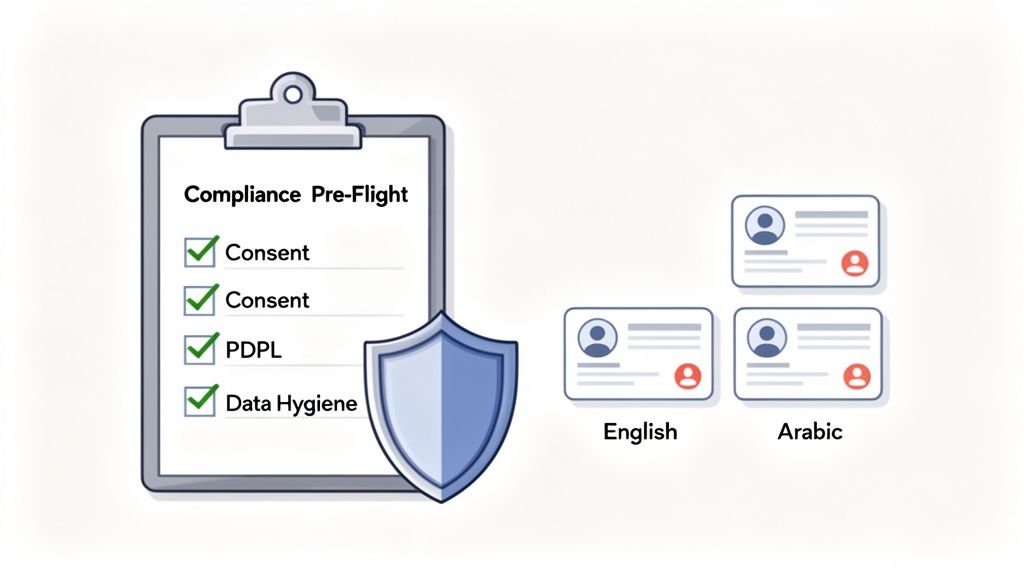
The success of your campaign is determined long before the first message is sent. For any business operating in the MENA region, this foundation is built on two pillars: strict compliance with local data laws and rigorous data hygiene within your CRM. Neglecting this stage doesn't just risk poor results; it exposes your business to legal penalties and can permanently damage your brand's deliverability. Launching with an unvetted contact list is like trying to build a sales pipeline on faulty ground—it’s destined to collapse.
Navigating MENA's Data Protection Landscape
In the GCC, data compliance is a core operational requirement. For any outbound campaign targeting contacts in the UAE, the starting point is documented consent. The country’s Personal Data Protection Law (PDPL), effective since January 2, 2022, mandates clear consent and a specific purpose for using personal data, with significant fines for violations.
For sales and marketing teams, this has a direct impact on your CRM workflows. Your pre-launch checklist must include a step to verify the source and timestamp of consent for every contact you intend to engage. Repurposing a list from a webinar for a cold sales sequence is a direct violation.
- Documented Consent: Can you prove, within your CRM, where and when each contact opted in? This requires a timestamped log from a web form, a WhatsApp Business API opt-in, or a similar digital record.
- Clear Opt-Outs: Every message, regardless of channel, must provide a simple, one-step unsubscribe mechanism. For WhatsApp, this is typically a keyword reply like "STOP."
- Purpose Limitation: Was the data collected with the explicit understanding it would be used for this type of campaign? This is a frequent compliance failure point.
Your CRM is your system of record for compliance. Implementing mandatory fields for 'Consent Source' and 'Consent Date' for every contact is a practical first step to building a defensible outbound process.
The Power of Granular CRM Segmentation
With compliance confirmed, the next step is to segment your contact lists for relevance. Sending a generic broadcast to your entire database is an inefficient way to generate unsubscribes. In the diverse MENA market, segmentation is crucial for making your message resonate. For a deeper dive into safeguarding sensitive customer data, consult this a modern guide to PII data compliance in analytics.
Use the data already in your CRM to create practical segments:
- Language Preference (Arabic/English): This is a fundamental requirement. Sending an English-only campaign to contacts who have only engaged in Arabic reflects poorly on your operational attention to detail.
- Engagement History: Separate your highly engaged contacts (e.g., opened the last three emails) from dormant ones. Each group requires a different messaging strategy and cadence.
- Sales Funnel Stage: A new lead from your website needs educational content. A contact who recently completed a demo requires a direct, conversion-focused message. Your CRM automation should prevent these from being mixed.
By ensuring your data is both compliant and intelligently segmented, you establish a foundation that not only mitigates legal risk but also dramatically improves campaign performance by delivering a more respectful and relevant customer experience.
Phase 2: Multi-Channel Message Strategy
A clean, segmented, and compliant contact list is only half the battle. Now, you must craft the message itself. A successful outbound launch depends on creating communication that feels personal and context-aware, not like an automated blast. Across the MENA region, this means tailoring your outreach for the specific rules and etiquette of email, WhatsApp, SMS, and AI voice. A one-size-fits-all message is the fastest way to be ignored or marked as spam.
Tailor Your Message to the Channel
Each communication channel has a different purpose and user expectation. Your messaging must respect these nuances to be effective.
- Email: Use this channel for structured, value-driven content. Present a clear business case, share a detailed case study, or link to an in-depth resource. Email is a professional medium that allows for more comprehensive messaging.
- WhatsApp: This channel demands brevity, personality, and immediacy. Messages should be short, conversational, and interactive. Use it for quick questions, appointment confirmations, or brief updates. Long, formal paragraphs are intrusive here.
- SMS: Like WhatsApp, SMS is for concise, urgent communication. It's highly effective for time-sensitive alerts, delivery notifications, or simple reminders. Avoid embedding complex links or rich media.
- AI Voice: Outbound AI voice scripts must be exceptionally clear and direct. State the purpose of the call in the first few seconds and provide an immediate, easy option to opt out or connect with a human agent.
The core principle of a multi-channel strategy is context. A person checking WhatsApp on their phone is in a different mindset than when they are clearing their work email inbox. Your message must align with that context to succeed.
Managing Arabic and English Workflows
For any MENA-focused campaign, managing bilingual communication is a critical operational task. Simply translating an English message into Arabic is insufficient; the tone, cultural nuances, and calls-to-action often require complete localization.
Your CRM must be the single source of truth for a contact's language preference. A simple automation rule can then use this data point to enroll contacts into the correct sequence—one designed entirely in Arabic, the other in English. This prevents embarrassing errors and shows a fundamental respect for your audience's preference.
Personalize Content with Market-Specific Triggers
To truly connect, especially in B2B sales, your outreach must demonstrate you understand the prospect's business environment. Instead of a generic pitch, reference specific market activities. For example, you can mention recent funding rounds in their industry, new regulations impacting their operations, or hiring trends you've observed. This level of personalization immediately elevates your message from a sales pitch to a valuable business insight, proving you’ve done your research.
This is where your sales and marketing workflows must align. Your team should be trained to use market intelligence to inform their outreach, turning generic templates into highly relevant, one-to-one conversations. For more on this, see A Modern Guide to Multi-Channel Marketing Automation.
Phase 3: Technical and Automation Setup
With a compliant list and a clear message strategy, the next phase is configuring the technical workflows in your CRM and automation platforms. This is the engine of your campaign, where a single misconfiguration in your email, WhatsApp, or SMS setup can halt the entire operation or damage your sender reputation. This stage is about methodical setup, smart automation, and ensuring all systems communicate correctly.
The workflow breaks down into three core components: segmenting your audience, crafting the message, and automating the delivery.
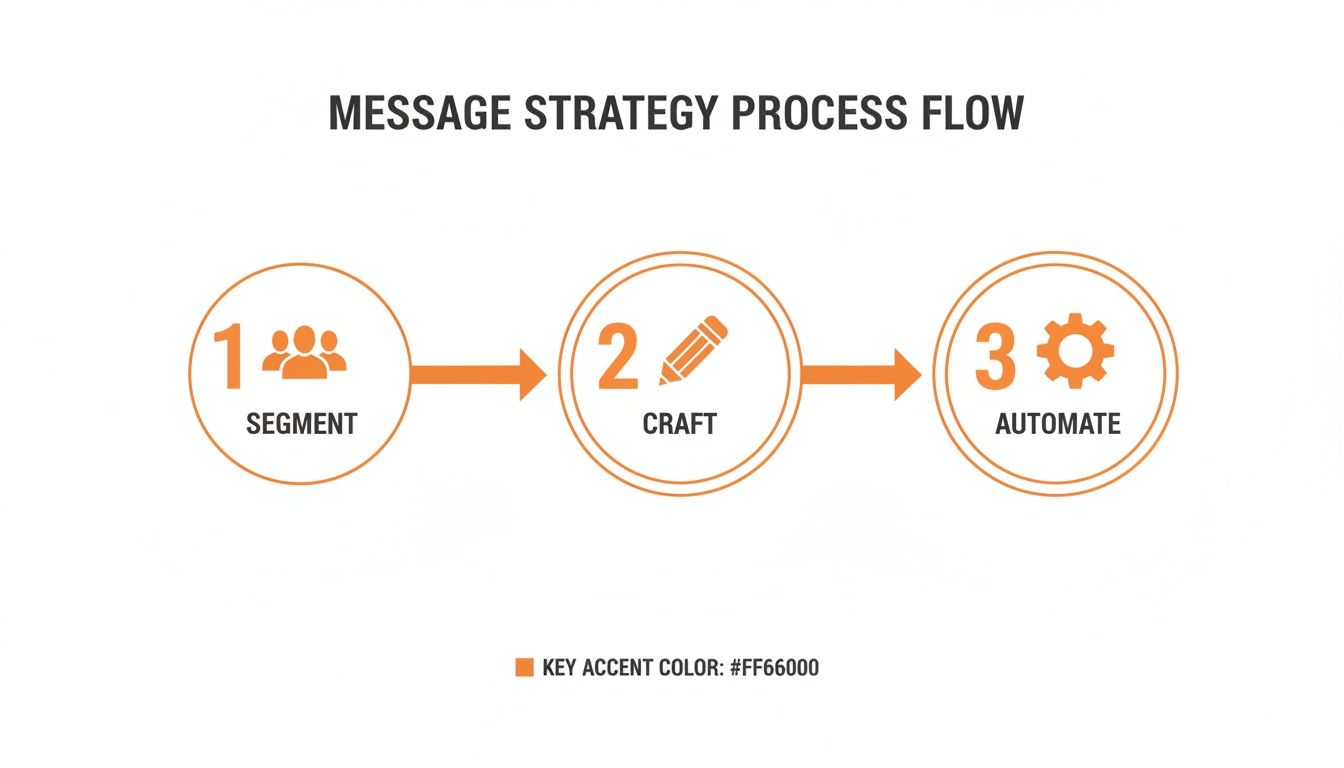
Automation is the final step that activates your strategy. Without a solid technical foundation, even the best segmentation and messaging will fail to deliver.
Laying the Infrastructure Groundwork
Before launching, you must properly configure and warm up your sending channels. Skipping this step is a common but critical error that leads to long-term damage to your brand's ability to communicate.
- Email Domain Warm-Up: Never send high-volume email campaigns from a new or dormant domain. Gradually increase your sending volume over several weeks to build a positive reputation with email providers like Gmail and Microsoft. This process is non-negotiable for ensuring deliverability.
- WhatsApp Business API Validation: Ensure your WhatsApp Business Account (WABA) is fully verified and correctly connected to your CRM or automation platform. All message templates for proactive outreach must be pre-approved by Meta. Using unapproved templates is a fast track to getting your number blocked.
- SMS Sender ID Registration: In many MENA countries, you must register an alphanumeric Sender ID (e.g., "YourBrand") with local carriers to send business SMS. This is essential for deliverability and brand professionalism.
A common mistake is assuming a connected channel is a ready channel. You must actively build and protect the reputation of each sending asset. A blacklisted email domain or a blocked WhatsApp number can disrupt your sales operations for weeks.
Channel-Specific Pre-Launch Technical Checklist
Use this table as a practical checklist to ensure your technical infrastructure is ready before you go live.
Building Smart Automation Sequences
An effective automation sequence is an intelligent system that reacts to prospect behavior. A critical rule is to stop the automation when a human conversation begins. If a prospect replies positively to your first email, the workflow must immediately remove them from all subsequent automated follow-ups. Sending another automated message after they've replied signals that your systems are disconnected.
For a practical guide on designing these workflows, see our article on building effective CRM email sequences for outbound sales.
Mapping CRM Triggers and Throttling Sends
The final layer is tying your CRM data directly to automation triggers. A custom field like "Language Preference" should be the trigger that determines whether a contact receives the Arabic or English campaign.
Equally important is building fallback logic. If a WhatsApp message fails to deliver, a well-designed workflow should automatically attempt another channel, like SMS or email, after a predefined delay. Finally, throttle your sends. Blasting thousands of messages simultaneously is a clear spam signal. Configure your system to send in smaller, spaced-out batches throughout the day to mimic natural human behavior and protect your sender reputation.
Phase 4: Meticulous Pre-Launch QA and Testing
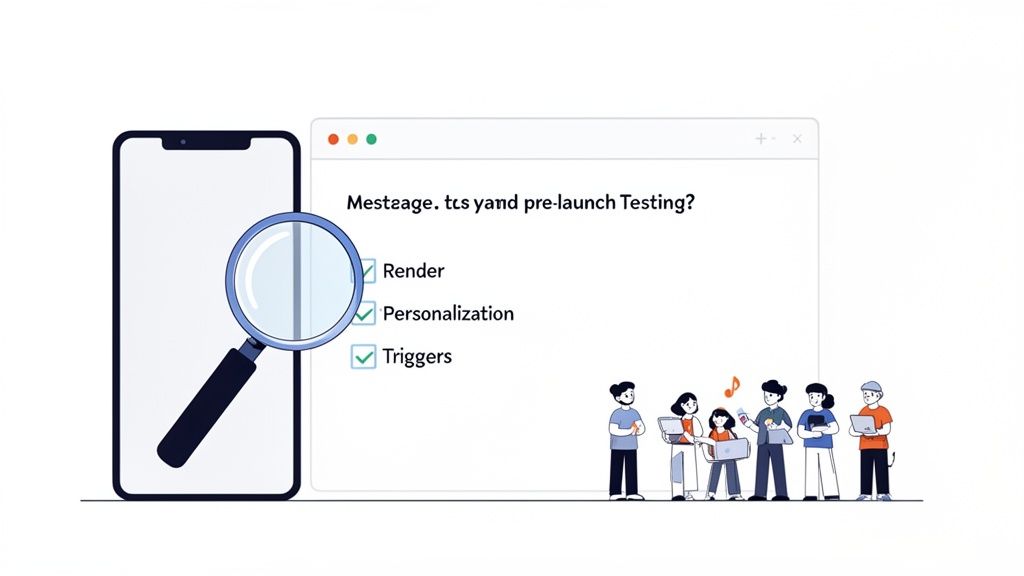
After strategy, list building, and technical setup, the Quality Assurance (QA) phase is your final, non-negotiable safety check. This is where you catch operational errors like a broken link, a personalization tag displaying {first_name} instead of a name, or an automation that fails to stop after a reply. Skipping this step directly threatens your brand reputation and the customer experience.
Your Internal Testing Checklist
Before any message reaches a prospect, your internal team must act as the customer. Send a series of tests to an internal group of contacts configured in your CRM with varied data to simulate real-world profiles.
- Render and Link Check: Test messages on major email clients (Gmail, Outlook) and devices (iOS, Android). Do images load correctly? Does Arabic text align properly? Click every link to ensure it directs to the correct URL and that tracking pixels fire as expected.
- Personalization Tag Verification: Confirm all custom fields—like
{first_name}and{company_name}—are pulling the correct data from the CRM. Test a profile with missing data to see how your system’s fallback logic performs. - Sender and Reply-To Addresses: Verify the sender name and email are correct. Send a test reply to ensure it is routed to the correct sales inbox or individual representative.
For larger teams, it's wise to build in a formal approval process. To get a handle on this, you can learn how to prevent outbound email mistakes with approval workflows.
Simulate the Entire Automation Journey
Testing a single message is simple; validating an entire automated sequence is critical. You must simulate the complete user journey to ensure the logic works under various conditions.
The most dangerous assumption in automation is that the system will behave as expected. You must test for every scenario: positive replies, negative replies, out-of-office responses, and no response. Only then can you trust it under real-world conditions.
Here’s a practical testing workflow:
- Trigger the sequence for a test contact. Verify the first message arrives and renders perfectly.
- Wait for the delay period. If you set a two-day delay, confirm the follow-up arrives on schedule.
- Reply positively from the test account. The system must immediately stop all future messages and update the lead status in the CRM.
- Reset and reply with a negative keyword like "unsubscribe." The system must instantly opt the contact out and tag them accordingly.
- Do nothing. Let the full sequence run for a silent test contact to ensure all timed delays and follow-ups execute in the correct order without intervention.
This step-by-step validation is a cornerstone of any safe outbound campaign launch checklist. The time spent here is minimal compared to the time required to clean up the damage from a broken sequence sent to hundreds of prospects.
Phase 5: Live Monitoring and Performance Analysis
Launching the campaign is not the end of the process. From the moment the first message is sent, your focus must shift to real-time monitoring. This isn't about checking a report at the end of the week; it's about having a live dashboard that shows you what is happening right now. This immediate feedback allows you to address issues and capitalize on opportunities as they arise.
Setting Up Your Monitoring Dashboards
Before launch, your monitoring dashboard must be built and tested. This central view should pull live data from your CRM and automation tools, covering every channel in your campaign—email, WhatsApp, SMS, and voice.
Track these crucial Key Performance Indicators (KPIs) from the first minute:
- Deliverability: Are messages being delivered successfully? Monitor email bounce rates and WhatsApp/SMS failed-delivery notifications. A sudden spike is a critical alert.
- Engagement: Track email open rates and WhatsApp read receipts. These provide a quick indication of whether your subject lines and opening hooks are effective.
- Replies: This is your most important early metric. A reply rate below 2% often indicates a problem with your targeting, messaging, or offer.
- Conversions: How many positive replies convert to booked meetings? How many are marked as "qualified" in the CRM? This tells you if you are engaging the right audience.
Turning Data into Operational Decisions
Data is useless without interpretation. A high open rate combined with a low reply rate suggests a compelling subject line but a weak message body that fails to deliver on the initial promise. Conversely, a low open rate with a high reply rate from the few who open indicates a strong message that isn't being seen, likely due to a poor subject line or deliverability issues.
Use these insights to make rapid adjustments. If a specific email in your sequence is underperforming, rewrite it. If Arabic WhatsApp messages are outperforming English emails, re-evaluate your channel and language segmentation strategy. Our guide on lead scoring and auto-routing in your CRM can show you how to automate responses based on this incoming data.
Establishing an Escalation Plan and Feedback Loop
Not every reply will be positive. You need a documented process for handling negative responses, unsubscribe requests, and technical complaints. Where possible, automate this process. For example, a reply containing "unsubscribe" should trigger a workflow that immediately opts the contact out across all channels.
Finally, maintain a tight feedback loop between your marketing and sales teams. Sales representatives are on the front line, hearing direct feedback on your messaging. A brief weekly sync to review replies and call notes provides invaluable qualitative context for your dashboard data, enabling continuous optimization of your outbound campaigns.
Frequently Asked Questions
Launching a safe and effective outbound campaign requires attention to detail. Here are answers to common questions from business leaders and operations managers in the MENA region.
How often should we update our outbound campaign checklist?
Your checklist should be a living document, reviewed at least quarterly and before every major campaign launch. Regulations around data privacy in the UAE and Saudi Arabia evolve, and platforms like WhatsApp and Google continuously update their policies. A regular review ensures your processes remain compliant and effective. Furthermore, an immediate review is necessary if you notice a sudden drop in key metrics like deliverability or reply rates, as this often indicates a new technical or compliance issue.
What is the biggest mistake companies in the UAE make with outbound?
The most common and damaging mistake is treating data acquisition and consent as an afterthought. Many businesses are still tempted to use purchased lists or repurpose data collected for other purposes without explicit consent for outbound marketing. This practice violates local data protection laws like PDPL, results in poor campaign performance, and severely damages your sender reputation, making it difficult for even legitimate communications to reach their intended recipients. A safe launch always starts with a clean, permission-based contact list.
How do we manage bilingual campaigns without doubling our workload?
Efficiently managing both Arabic and English campaigns depends on smart automation, not increased manual effort. The key is to use a dedicated 'Preferred Language' field in your CRM for every contact. This data point acts as a trigger, automatically routing contacts into the correct, pre-built workflow. You will create two parallel message sequences—one in Arabic, one in English. The system then handles the deployment, ensuring each contact receives communication in their preferred language without manual intervention, preventing errors and saving significant team resources.
What is a realistic open rate for a B2B email campaign in the GCC?
For a well-segmented, permission-based B2B email campaign targeting professionals in the GCC, a realistic open rate typically falls between 25% and 40%. This can vary based on the engagement level of your list and your sender reputation. A highly personalized message addressing specific regional business challenges, sent from a properly warmed-up domain, will consistently perform at the higher end of this range. While open rates are a useful health metric, the ultimate measure of success remains the metrics that drive business outcomes: positive replies and meetings booked.
At SMOrchestra, we design and operate the AI-powered sales and marketing systems that help MENA businesses grow predictably. We build the multi-channel outbound, CRM, and automation workflows that turn strategy into sales.