
Building predictable lead flow without ad agencies: Own your pipeline now
Relying on an ad agency for leads is like renting a house. It gets the job done for a while, but the moment you stop paying rent, you’re out on the street. The flow of new business just… stops.
Building predictable lead flow without ad agencies is about owning your pipeline. It’s about creating an in-house, CRM-driven system that belongs to you—a permanent, revenue-generating asset that delivers consistent, forecastable growth.
The Agency Trap: Why Renting Traffic Fails in MENA
For many businesses in the MENA region, the cycle is painfully familiar. You pour money into a digital ad campaign, get a temporary spike in traffic, and then… silence. The pipeline dries up the second the budget runs out.
This is the "Agency Trap." It’s a state of dependency where you're perpetually paying for access to customers instead of building your own system to engage them. This creates a stressful feast-or-famine environment, making any kind of sales forecasting a complete guessing game. The problem is that agencies are experts at hunting for leads through short-term campaigns. An in-house, CRM-driven outbound system is about farming—cultivating a predictable process you own and control from start to finish.
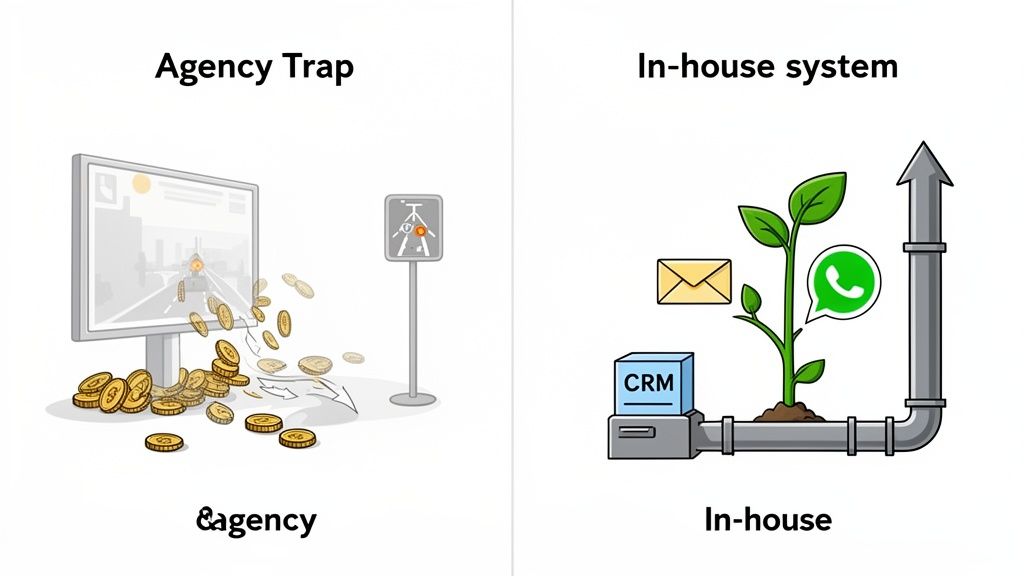
From Renting Clicks to Owning Your Pipeline
Breaking free from this cycle means making a strategic shift from renting visibility to owning your lead generation machine. This machine is powered by your CRM, integrated with automated outbound systems that use email, WhatsApp, SMS, and even AI voice. The goal is simple: create a compounding asset where every dirham or riyal invested improves the system's long-term output.
Here’s how an owned, CRM-driven outbound system changes the game:
- Predictable Costs: Your expenses are tied to scalable technology and your team, not the wild, fluctuating prices of ad auctions.
- Deeper Customer Insights: Every interaction—from the first WhatsApp message in Arabic to the final sales call in English—lives inside your CRM, giving you a crystal-clear picture of your customer’s journey.
- Compounding Results: Every new contact, every successful email sequence, and every automated workflow makes your entire system smarter and more effective over time.
This approach is especially critical in the MENA market. While digital ad spend is high, investment in the CRM-driven workflows needed to convert that traffic is often overlooked. This gap tells a clear story: most companies are still just buying traffic, not building the systems to turn it into a reliable sales pipeline.
Agency-Led Campaigns vs In-House Lead Systems: A Comparison
Ultimately, the choice is between a short-term fix and a long-term solution. One gives you a quick hit, while the other builds lasting business value through a resilient, scalable, and entirely owned revenue engine.
Hunting vs. Farming: Two Paths to Growth
Think of it like this. The agency model is a hunter who has to find food every day. Each campaign is a new hunt, with no guarantee of success. It’s exhausting.
Now, imagine a farmer. The farmer plants seeds, nurtures the soil, and builds an irrigation system. Their effort is cumulative, leading to a predictable harvest, season after season.
An owned, CRM-driven system turns your sales and marketing efforts from a daily hunt into a sustainable farm. You're no longer just chasing this month's target; you're building the infrastructure for next year's growth.
This transition from renting to owning is the foundation of a predictable, agency-free lead flow. Instead of relying on someone else to manage your pipeline, you take direct control. You leverage your CRM and automation to create powerful bilingual workflows—in both Arabic and English—that engage prospects consistently. To see a detailed breakdown of how this stacks up against traditional advertising, check out this comparison of outbound marketing versus paid ads.
How To Design Your In-House Lead Engine
Think of your in-house lead generation system as an engine. You can't just bolt parts together and hope for the best. You need a blueprint. A poorly designed engine will sputter and fail, but a well-designed one becomes a predictable, powerful revenue machine.
This blueprint boils down to two fundamental pieces you must lock in before touching any technology. First, who exactly are you trying to reach? Second, how will you measure success? Everything else—the channels you use, the software you buy, the emails you write—flows directly from those two decisions.
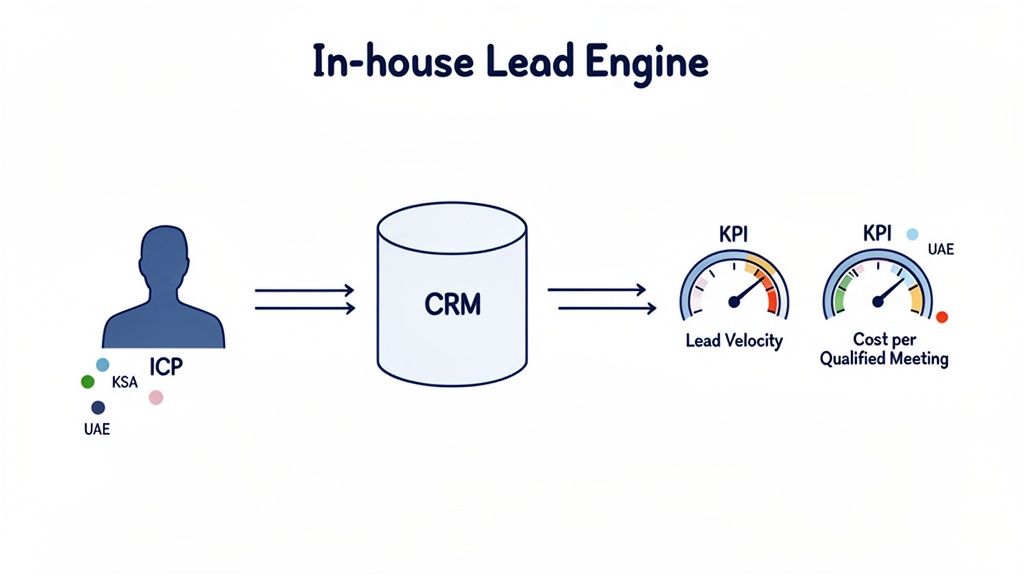
Define Your Ideal Customer Profile for MENA
Your Ideal Customer Profile (ICP) is a crystal-clear picture of the perfect customer for your business, demanding a real, on-the-ground understanding of the local market. An ICP for a software firm in Riyadh looks completely different from one for a logistics company in Dubai.
Get specific by asking these kinds of questions:
- Industry Focus: Are you targeting the booming construction sector in Saudi Arabia, the logistics hubs in the UAE, or the growing fintech scene in Bahrain?
- Company Size: Are your best customers SMEs with 50 employees or enterprises with over 500? This changes everything about your sales cycle.
- Decision-Maker Language: Does the buyer prefer to communicate in Arabic, English, or a mix? Your outreach on channels like WhatsApp and your contact center scripts must match this preference.
- Technology Stack: What CRM or ERP systems are they already using? Knowing this helps you tailor your pitch around seamless integration and immediate value.
Without a laser-focused ICP, your team will burn time and money chasing leads who were never going to buy. A solid ICP ensures every outbound effort is aimed at high-potential accounts.
Move Past Vanity Metrics to Pipeline KPIs
Once you know who you're after, you need to define what success actually looks like. Ad agencies love reporting on vanity metrics—clicks, impressions, and website traffic. Those numbers look impressive but don't tell you if your business is growing.
An in-house lead engine isn't measured by activity; it's measured by pipeline health and revenue impact. Your KPIs must reflect the actual movement of leads through your sales funnel, from initial contact to a closed deal.
This is a mindset shift. It means ditching agency-style metrics and adopting KPIs that track the true health of your sales pipeline inside your CRM. To power your in-house lead engine with automated solutions and track these interactions effectively, discover how to utilize a chatbot for lead generation as your ultimate growth engine.
Here are the pipeline KPIs that actually move the needle:
By locking in your ICP and tracking these powerful pipeline KPIs in your CRM, you create a direct line between who you're targeting and how you measure success. This alignment is the core of building a predictable lead flow without ad agencies. It engineers your entire system for one purpose: creating a reliable and scalable revenue stream that you own and control.
Choosing Your Channels For Consistent Outreach
You’ve done the foundational work: you know your ICP and your KPIs. Now it's time to choose the channels that will bring those ideal customers to your doorstep. The goal is not to pay platforms like Google or Meta to "rent" their audience. Instead, we’re building a powerful mix of outbound channels that you own and control, plugging directly into your CRM to create a direct line of communication.
This isn't just a tactical shift; it reflects a bigger trend in the MENA region. Gut-feel outreach is losing its punch. Businesses are moving towards measurable, digital-first ways of winning customers because they realize the power of building their own funnels.
The Core Three Outbound Channels
Instead of casting a wide—and expensive—net with paid ads, a predictable system gets laser-focused on a few high-impact channels. This lets you master the workflow for each one, wire them into your CRM, and create a smooth, professional experience for your prospects.
The three pillars of a powerful in-house outbound system are:
- AI-Driven Email: Still the king of B2B communication. Modern email automation lets you send personalized, multi-step campaigns that warm up leads over time, all executed from your CRM.
- Strategic AI Voice: Forget clunky robocalls. Today's AI voice agents handle initial qualifying questions, book meetings, and follow up in a natural way, making it a game-changer for waking up cold leads.
- High-Engagement WhatsApp: In the MENA region, WhatsApp is a business powerhouse. You can use automated flows to send instant follow-ups, deliver valuable content, and engage prospects right where they spend their time—on their phones.
Tailoring Channels to Your MENA Audience
Just using these channels isn't enough. A generic, one-size-fits-all strategy will fall flat. Your plan must be built around how your specific customers in the region actually communicate.
A predictable pipeline isn’t about having the most channels; it’s about having the right channels, integrated seamlessly and automated intelligently. The goal is to meet your customers where they already are.
Let’s make this real. Imagine a Dubai-based B2B tech firm targeting enterprise clients. They might rely on a sophisticated, English-language email sequence triggered after a webinar. An AI voice agent could then call the most engaged leads to schedule a demo.
Now, picture a Riyadh-based e-commerce store. For them, WhatsApp is pure gold. They could build automated flows in Arabic to confirm orders, win back abandoned carts with a discount, and instantly answer common questions, freeing up their customer service team.
Integrating Channels for a Cohesive Journey
These channels cannot operate in silos. The real power is unlocked when you orchestrate them from within your CRM to create one seamless customer journey. This is the heart of running successful multi-channel outbound campaigns for MENA SMEs.
Here’s what that looks like in practice:
- Triggered Sequences: A prospect fills out a form. That action instantly triggers a bilingual welcome email and a WhatsApp message confirming receipt of their info.
- Intelligent Follow-Up: If they don't open the first two emails, the system can automatically schedule a quick follow-up call from an AI voice agent a few days later. No lead slips through the cracks.
- Sales Team Alerts: The second a lead clicks a key link in an email or replies to a WhatsApp message, your CRM can ping a salesperson with a task to follow up personally.
By connecting these channels, you create a system that’s persistent, responsive, and always pushing the conversation forward. You’re no longer just blasting out messages; you're designing a journey that methodically qualifies leads and hands them to your sales team at the perfect moment. This integrated machine is the engine of building predictable lead flow without ad agencies, ensuring every interaction is tracked, measured, and optimized.
Building Automated Workflows That Convert
A predictable lead flow doesn't just happen because you picked the right channels. It's built on automated workflows humming along inside your CRM. Think of these workflows as your tireless, 24/7 digital sales team. They never sleep, never miss a follow-up, and execute your strategy flawlessly every time, moving leads from interest to a real sales conversation.
This isn't abstract theory. It’s a practical, mechanical process you build right inside your CRM. To make this system work without agencies, you only need to master three core workflows: Capture, Nurture, and Close. These are the gears that turn scattered inquiries into a structured, reliable pipeline.
This diagram shows how you can weave different channels together—like email, AI-powered voice calls, and WhatsApp—to engage leads in a structured way.
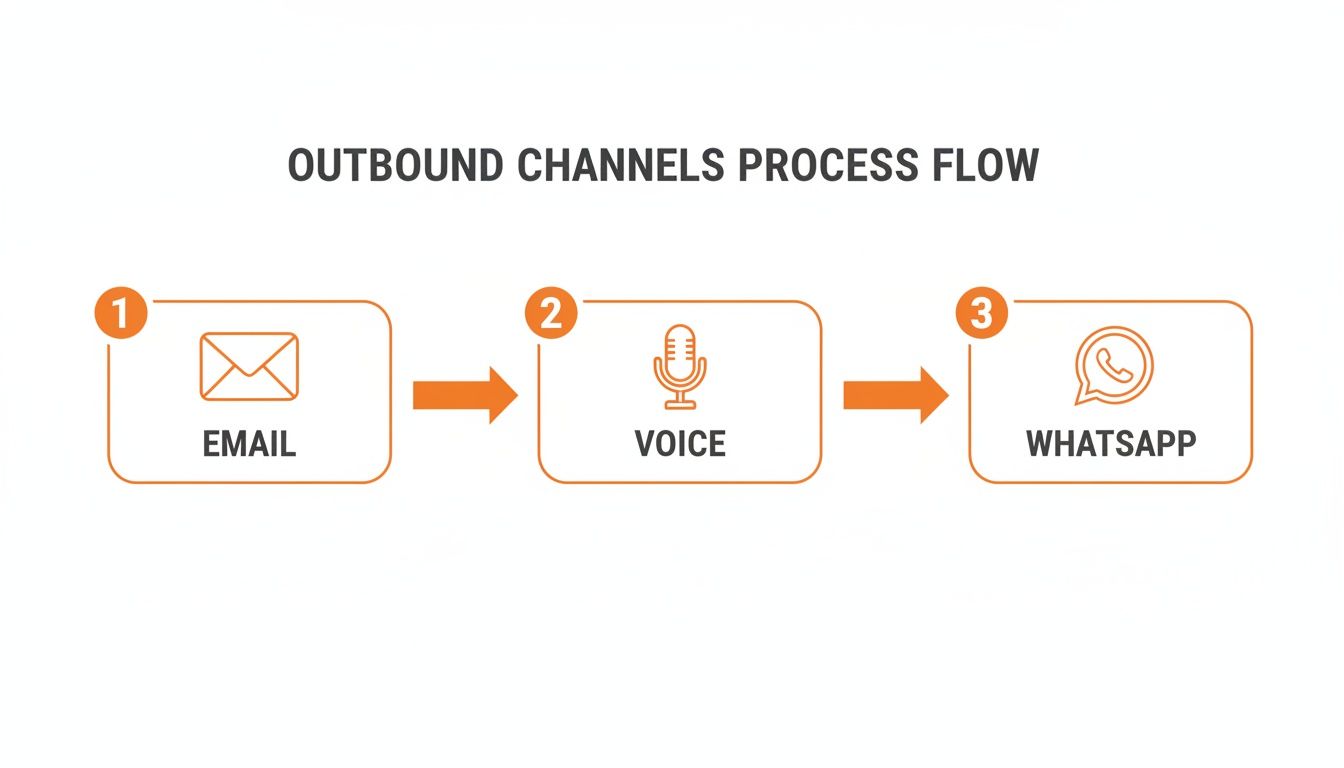
The real magic here is orchestration. It’s about using each channel for what it does best to create a journey that feels both responsive and persistent.
Workflow 1: The Capture Engine
First, you have to stop leads from falling through the cracks. Your Capture workflow is like a powerful vacuum, instantly pulling every new inquiry from all your channels directly into your CRM. This ends the chaos of juggling leads from spreadsheets, messy inboxes, and random WhatsApp chats.
To ensure your automations have good data to work with, it’s critical to use form design best practices. A clean, simple form means more leads and better information.
A well-oiled Capture workflow will instantly:
- Grab data from website forms the moment someone hits "submit" and create a new contact in your CRM.
- Log inquiries from WhatsApp chats, automatically tagging them by source.
- Import leads from social media DMs or lead ads without any manual copy-pasting.
This centralization is the foundation. It guarantees every single lead is accounted for and ready for the next step.
Workflow 2: The Bilingual Nurture Sequence
Once a lead is in the system, the Nurture workflow takes over. This is where you build trust and educate prospects automatically. It’s a carefully planned, multi-channel follow-up sequence designed to keep your business top-of-mind.
For businesses in the MENA region, this must be a bilingual process. If someone reaches out in Arabic, they should get follow-ups in Arabic. If they use English, stick to English. Your CRM automation should be smart enough to handle this language preference seamlessly.
Your Nurture workflow is an automated conversation starter. It uses a smart mix of email, SMS, and AI voice calls to deliver the right message at the right time, warming up prospects until they're ready to talk to a human.
Let's imagine a UAE real estate developer. Their automated sequence for new property inquiries could look like this:
- Instantly: An automated WhatsApp message (in the lead’s language) confirms their inquiry and sends a digital brochure.
- Day 2: An email follows up with a link to a virtual tour.
- Day 4: An AI voice agent places a quick, friendly call to ask if they have any initial questions.
- Day 7: An SMS provides a direct link to book a viewing in a sales agent's calendar.
This methodical follow-up ensures no lead goes cold.
Workflow 3: The Sales-Ready Close Trigger
The final piece is the Close workflow. Its job is to bridge your automated system and your human sales team. This workflow watches for buying signals and fires off an alert the moment a prospect shows they're ready to move forward.
Think of it as an intelligent tripwire. When a lead takes a specific action, the system knows it's time for a salesperson to step in.
This workflow can trigger actions like:
- Creating a task for a sales rep when a lead clicks the pricing link in your email for the third time.
- Sending a real-time notification to the sales manager when a prospect replies to a WhatsApp message asking about availability.
- Changing a lead's status in the CRM to "Hot" after they watch 75% of your demo video.
This logic ensures your sales team invests their time on the hottest opportunities, massively boosting efficiency and close rates. When you combine these three workflows, you create a self-sustaining system that captures, nurtures, and qualifies leads predictably and at scale.
How to Select the Right Technology Stack
Picking the right technology can feel overwhelming, but it doesn't have to be. Your tech stack is the engine that drives your entire lead generation system—the machine that works for you without an outside agency. The goal isn't to collect every shiny new tool; it's to choose a few powerful components that work together perfectly.
Your in-house lead engine only needs to be built on three core pillars. These are the operational backbone for capturing leads, nurturing them, and closing deals.
The Three Core Pillars of Your Stack
Your whole lead generation machine stands on the foundation of three key pieces of technology. Each has a specific job, but they all talk to each other to turn prospects into customers.
- Your CRM: The Central Hub. This is your single source of truth. Your Customer Relationship Management (CRM) system is where every lead, interaction, and customer data point lives. It’s the brain of the operation.
- Conversational AI: The Frontline Engagement. In the MENA region, tools that integrate with channels like WhatsApp are non-negotiable. Conversational AI lets you automate initial qualification and answer common questions in Arabic and English, offering instant, 24/7 engagement.
- Multi-Channel Automation: The Workhorse. This system does the heavy lifting. A solid automation platform handles your email sequences, SMS follow-ups, and AI-powered voice calls. It runs your nurturing workflows tirelessly in the background.
Must-Have Features for the MENA Market
Generic, off-the-shelf software often misses the mark for businesses in the UAE, KSA, and across the wider region. Your technology must handle the unique communication nuances of your customers.
A great tech stack doesn't just automate tasks; it understands and adapts to your local market. Choosing tools without strong bilingual capabilities is like building an engine with mismatched parts—it’s destined to fail.
When evaluating software, make these features your top priority:
- Robust Arabic Language Support: The platform and all customer-facing messages must work flawlessly in Arabic.
- Full Right-to-Left (RTL) Capabilities: Text, email templates, and web forms must display correctly in Arabic without looking broken.
- Seamless Bilingual Management: The system must make it easy to manage and automate communications in both Arabic and English, switching based on customer preference.
This focus on owning integrated technology is a major strategic shift. A recent full lead generation market analysis projects the global industry will hit USD 32.1 billion by 2035, highlighting MENA as a huge growth area. The report also notes that SMEs are turning to owned channels like email marketing as a more cost-effective way to engage prospects than paying hefty agency retainers.
A Practical Checklist for Choosing Your Tools
Don't get swayed by brand names alone. Use this practical checklist to ensure the technology can support the automated workflows you’re building. For a deep dive on the most critical component, check out our guide on choosing the best CRM for small business.
When vetting tools, ask these simple but crucial questions:
By sticking to these principles, you can build a lean, powerful tech stack that lets you create a predictable, agency-free lead generation system designed specifically for your business.
How to Get Your System Up and Running
This is where the rubber meets the road. A word of advice: don't try to boil the ocean. I've seen too many businesses get excited and attempt a massive "big bang" launch, flipping the switch on everything at once. That's a recipe for chaos.
Building a predictable stream of leads without relying on agencies is a game of inches. You start small, prove the model works, and then expand it with confidence. The best way to do this is with a phased rollout.
Kick Things Off With a Pilot Program
Think of this as your test flight. Instead of overhauling your entire lead generation process, pick one specific, manageable area to focus on. This lets you work out the kinks and see what's actually working without putting your main sales pipeline at risk.
Here are a few ways to structure your pilot:
- Focus on one workflow: For instance, just activate the "Nurture" sequence for new leads coming from your website.
- Target one customer segment: Test the system exclusively on construction companies in Riyadh.
- Stick to a single channel: Start by rolling out the automated WhatsApp follow-up sequence and nothing else.
This creates a controlled environment where your team can get comfortable with the new tools, spot friction early, and build momentum before you go all-in.
Measure, Tweak, and Keep Improving
During this pilot phase, be glued to the pipeline KPIs you set up earlier. Things won't be perfect right out of the gate, and that's normal. The goal isn't perfection; it's about learning and improving, fast.
An in-house lead generation system isn't a one-and-done project. Think of it as a living asset for your business—one that you constantly fine-tune based on the real performance data from your CRM.
Keep an eye out for red flags. Are email open rates lower than you expected? Time to A/B test different subject lines in both Arabic and English. Is data from a web form not showing up correctly in the CRM? Fix that integration issue immediately. Fixing small problems early saves you from massive headaches later.
This cycle—measure, fix, repeat—is what transforms your system from a good idea into a powerful engine. You’re constantly refining who you talk to, what you say, and where you say it, all based on hard numbers. This is how you build a reliable, predictable source of revenue that you have complete control over.
Frequently Asked Questions
You've got questions, and we've got answers. Here are some of the most common things sales and operations leaders in MENA ask about building a predictable, agency-free lead generation system.
How Quickly Can I Actually See Results?
This is a different game than paid ads. While an ad campaign can get you clicks in an afternoon, building your own system is about sustainable, long-term growth.
You should expect to see the first qualified meetings appearing in your calendar from targeted outbound efforts (like smart emails or AI voice calls) within the first 30 to 60 days.
The real magic, though, is the compounding effect. Getting to a place of true predictability, where you can confidently forecast your lead flow, usually takes about 3 to 6 months. That's the time it takes to dial in your workflows and build a valuable database of nurtured contacts who know and trust you.
Is This Really Cheaper Than Hiring an Agency?
It’s a different kind of investment. Upfront, you'll invest in the right technology and dedicate team time to build the system. But when you look at the total cost over time, building in-house almost always comes out on top.
Think of it this way: agency retainers and ad spend are rent. The second you stop paying, it all disappears. Building your own CRM-driven system is like buying the property. It’s a capital investment that creates a permanent, revenue-generating asset for your business.
Your costs shift from being volatile and unpredictable (like ad auctions) to fixed and manageable (software subscriptions and your team's time). This makes forecasting your budget and revenue far more reliable.
Can My Current Sales Team Handle This?
Absolutely, and they'll probably thank you for it. The goal isn't to turn your top closers into marketing gurus. A properly built system automates the grunt work—the initial outreach, the relentless follow-ups, and the lead scoring.
This frees your sales team to do what they do best: have meaningful conversations with qualified people who are genuinely interested. They'll live in the CRM, picking up the warm leads the system delivers. It’s all about empowering them to close more deals without the burnout that comes from endless cold prospecting.
At SMOrchestra, we don't just talk about this stuff—we build it. We design, implement, and operate the AI-powered sales systems that create this exact kind of predictable pipeline for businesses across the MENA region. If you're ready to stop renting your leads and start owning your revenue engine, learn how SMOrchestra can build it for you.