The Real AI Revolution Isn’t Agents. It’s the Orchestrator
The Real AI Revolution Isn’t Agents. It’s the Orchestrator
For the last year, the AI conversation has been dominated by one idea: agents. Sales agents, support agents, booking agents, research agents. Every new product demo promises another “AI employee” that can reason, act, and replace manual work. The excitement is understandable. Agents feel like progress. They talk, decide, and execute.
But after spending the past six months rebuilding our entire AI infrastructure from the ground up, one uncomfortable truth emerged: agents are not the real breakthrough. The orchestrator behind them is.
Most AI stacks today are built by layering tools on top of each other. A chatbot here, an automation there, a CRM holding everything together. On the surface, it looks like an intelligent system. In practice, it behaves more like a collection of disconnected organs with no nervous system to coordinate them. This article explains why orchestration is the missing layer, how it changes AI system design, and why the next evolution in AI will be defined by cohesion, not by more agents.

When Everything Works, but Nothing Thinks Together
Many AI teams reach a familiar plateau. Each component performs its task correctly in isolation, yet the overall system feels brittle and unintelligent.
Chatbots understand conversations and retrieve context.
Automation tools respond to triggers and execute workflows.
CRMs store structured data, histories, and states.
Each part functions. None of them truly collaborate.
The chatbot does not understand operational constraints. The automation engine does not understand intent. The CRM remembers information but cannot reason about it. When something unexpected happens, humans step in to interpret, reroute, and repair the logic.
This is the hidden tax of most AI systems. Human operators become the glue. Every exception, edge case, or new scenario requires manual stitching between tools. The system appears automated, but intelligence lives outside it.
At this stage, adding more agents feels like the logical next step. If one agent is limited, add five more. Specialise them. Divide responsibilities. Unfortunately, this only increases complexity. Instead of one brittle system, you now have several. Each agent carries its own assumptions, logic, and interpretation of reality.
The problem was never a lack of intelligence. It was a lack of coordination.

Why More Agents Do Not Fix the Problem
Agents are good at reasoning within a narrow scope. They can decide what to say or what action to take next. What they cannot do on their own is maintain system-wide coherence.
Without orchestration, every agent becomes a silo. Context fragments. Memory duplicates. Conflicts emerge between tools. One agent updates the CRM, another triggers an automation, a third responds to the user, and none of them share a single source of truth.
This is where many teams unknowingly regress. They mistake local intelligence for system intelligence. The result is a fragile architecture that works during demos and collapses under real-world variance.
The breakthrough comes when you stop asking “how do we build smarter agents” and instead ask “who coordinates them.”

The Orchestrator as the Missing Layer
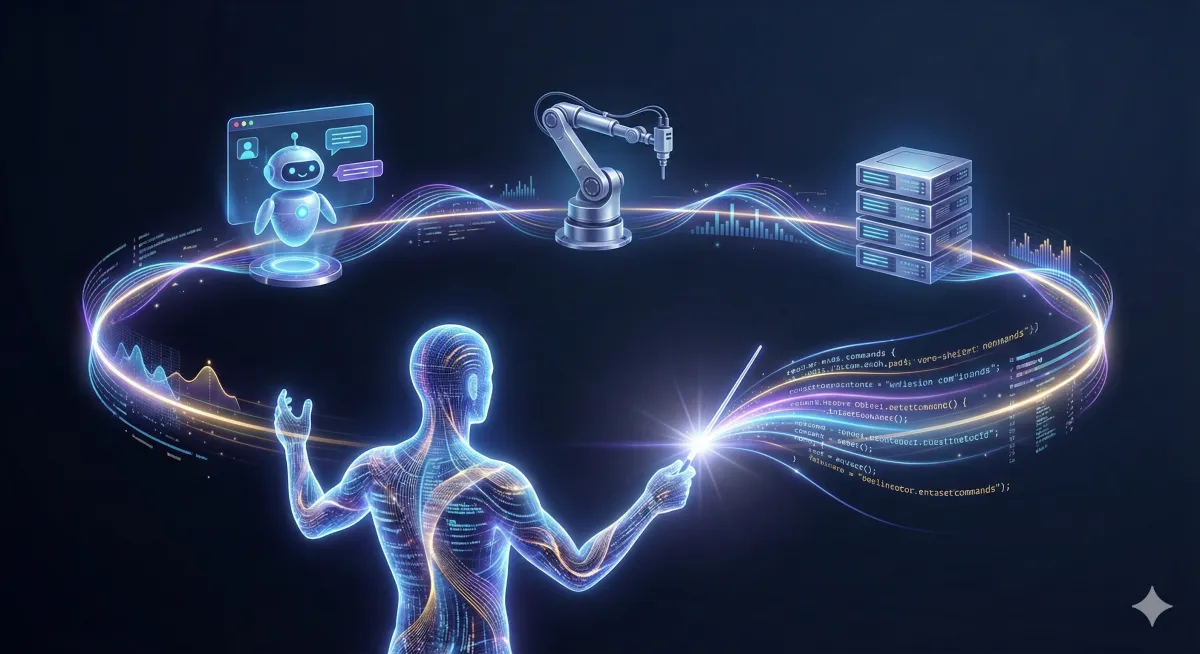
The orchestrator is not another agent. It is the system that decides which agent should act, when it should act, and under what constraints.
When OpenAI released Agent Workflow, the architectural shift became clear. The power was not in better reasoning, but in structured planning, routing, and control.
An orchestrator sits between thinking and doing. It interprets intent, plans sequences, enforces guardrails, and routes tasks to the appropriate tools or agents. Instead of letting every component act independently, it introduces a shared nervous system.
In biological terms, intelligence without nerves cannot move. Muscles may exist, and the brain may think, but without coordination nothing happens coherently. AI systems suffer from the same limitation.

Rebuilding Around Orchestration
Once orchestration becomes the foundation, the stack simplifies instead of growing.
Agent Workflow handles planning, routing, and guardrails.
Execution layers handle deterministic actions and integrations.
Specialised chatbot agents for sales, booking, support, and information plug into the same orchestration layer.
Instead of six independent bots, the system behaves like one multi-agent brain. Context flows naturally between components. Decisions remain consistent across channels. Memory becomes actionable instead of static.
Most importantly, humans are no longer responsible for stitching logic. They supervise the system rather than compensating for it.

From Automation to Agentic Systems
This distinction matters. Automation reacts to predefined triggers. Agentic systems adapt based on intent, state, and feedback. The difference is not intelligence alone. It is the feedback loop created by orchestration.
An orchestrated system continuously connects three layers: reasoning, automation, and memory. Each informs the other. Each updates the shared understanding of what is happening and what should happen next.
Without this loop, AI remains reactive. With it, AI becomes adaptive.

Why the Future of AI Is Architectural
The next evolution in AI will not be driven by larger models or more impressive demos. It will be driven by architecture. Systems that are designed to think together will outperform systems that merely think fast.
Teams that still rely on humans to manually route logic between tools are not building agentic systems. They are running automated workflows with conversational interfaces layered on top.
True intelligence emerges when coordination becomes native to the system.

AI Needs a Nervous System
A brain alone is not enough. Tools alone are not enough. Memory alone is not enough. Intelligence emerges when all three operate in synchrony.
That is what an AI orchestrator provides.
Once installed, chatbots stop acting in isolation. CRMs stop being passive databases. Workflows stop breaking at the first unexpected input. The system begins to reason, act, and remember as a whole.
This is the quiet revolution happening beneath the surface of modern AI. Not louder agents, but deeper coordination. Not more intelligence, but shared intelligence.
The future of AI belongs to systems that think together.